
Low Testosterone Treatment in Orlando begins with understanding the underlying cause of symptoms rather than making assumptions. Men with low testosterone may experience persistent fatigue despite adequate sleep, reduced muscle strength, lower motivation, mood changes, and a decline in sexual desire.
As these symptoms can also be linked to other health conditions, a comprehensive evaluation and laboratory testing are essential to determine whether low testosterone is the cause and to develop an appropriate, personalized treatment plan.
Low testosterone isn’t a feeling. It’s a number, and the number only matters when it’s read correctly. Total testosterone measures everything circulating in your blood, but a large share of that is bound to proteins and unavailable for your body to use.
Free testosterone vs total testosterone is one of the most important distinctions because a man can have a “normal” total number while his usable, free testosterone is quietly low.
This is where SHBG testosterone levels’ role begins. Sex hormone-binding globulin (SHBG) is the protein that locks testosterone away. When SHBG runs high, it can mask a real deficiency even when total testosterone looks acceptable on paper. A proper evaluation looks at total testosterone, free testosterone, and SHBG together, along with a low T symptoms checklist that covers fatigue, low libido, mood changes, reduced muscle mass, and brain fog.

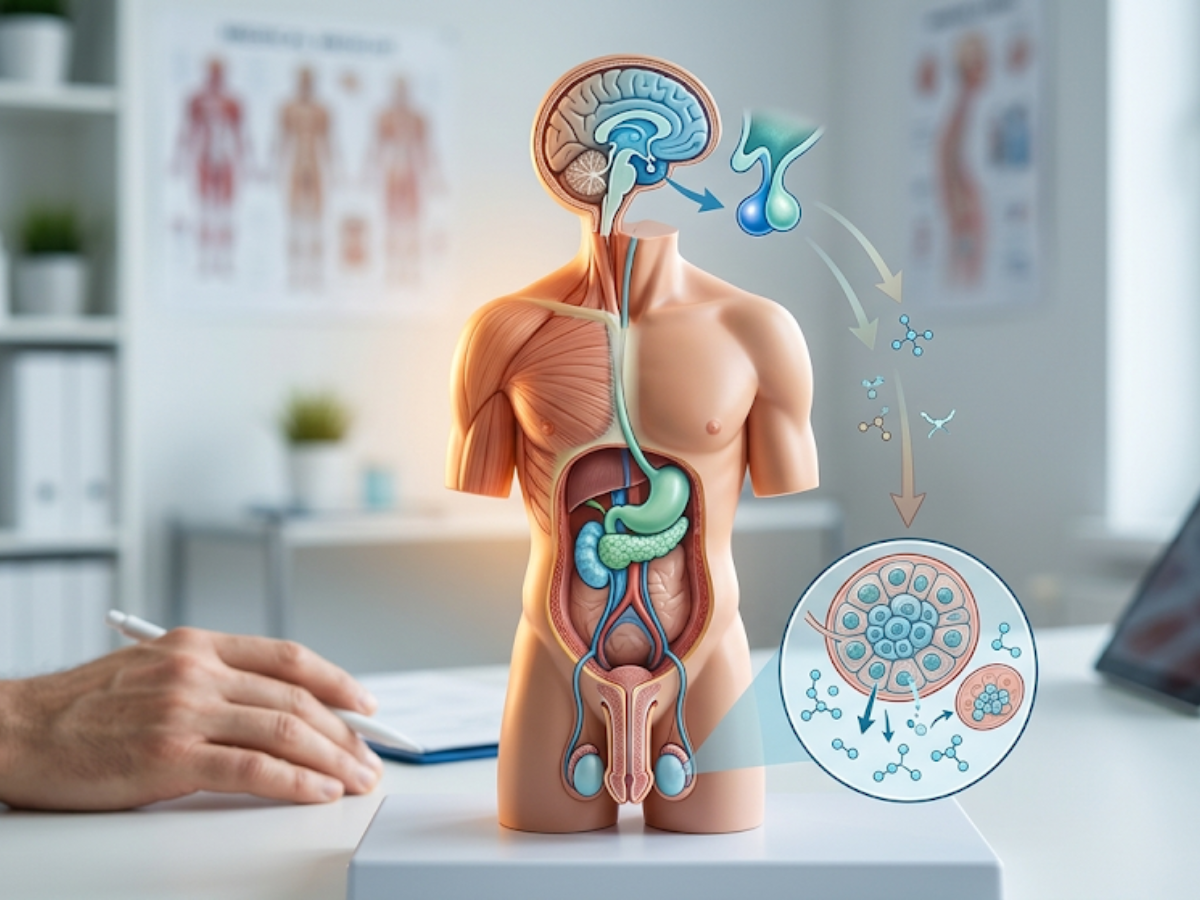
Testosterone naturally declines with age, typically dropping about one percent a year after 30. But age is only part of the picture. Among common testosterone deficiency causes are chronic stress and elevated cortisol, which compete with testosterone production at a hormonal level and can suppress it over time. Excess body fat also plays a role, since fat tissue converts testosterone into estrogen through an enzyme called aromatase, which lowers the testosterone available to your body.
Poor sleep, heavy alcohol use, certain medications, and metabolic conditions like insulin resistance all add to the load. Men often bring one complaint, like fatigue or weight gain, without realizing several of these factors are stacking on top of each other.
Understanding how chronic stress and cortisol affect your overall health can help you figure out why testosterone dropped in the first place.
Before you ever draw blood, there’s a simple starting point. The ADAM questionnaire testosterone screening tool (Androgen Deficiency in Aging Males) asks a short set of yes-or-no questions about energy, strength, mood, and sexual function. A positive ADAM screen should always be followed by actual lab work, not assumptions. This means:

Not every man with low-normal testosterone needs medication right away. For some, targeted lifestyle changes make a real, measurable difference. Effective natural testosterone boosters and habits include:
These steps won’t reverse significant hormonal deficiency on their own, but they build a healthier foundation and often improve how well medical therapy works if it’s needed later.
When labs confirm a genuine deficiency and lifestyle changes aren’t closing the gap, medical therapy becomes the next reasonable step. Hypogonadism treatment is not one-size-fits-all, and the right option depends on your labs, your goals, and how your body responds. Options generally include:
A well-run testosterone program is not a “start and forget” prescription. It’s a relationship built on repeat labs, dose adjustments, and honest conversations about what’s working and what isn’t. When properly managed, research suggests testosterone therapy can prolong life and improve survival — a meaningful consideration given that low testosterone itself is associated with increased mortality risk when left untreated. There’s also emerging evidence around the risks of leaving testosterone deficiency unaddressed or blocked, which underscores why an individualized approach matters.
Cardiovascular safety is often a top concern for men considering therapy, and the data here is more reassuring than many expect: several studies point to testosterone’s protective role for the heart, including further findings on testosterone and cardiovascular health, evidence that testosterone therapy may help prevent heart attacks in older men, and research on testosterone therapy’s effect on coronary plaque and calcium score.
Testosterone rarely operates alone. An underactive thyroid can mimic or worsen many of the same symptoms as low testosterone, including fatigue, weight gain, and brain fog, which is why thyroid labs belong in almost every workup.
Insulin resistance and low testosterone also feed each other in both directions, each making the other worse over time. And the connection between testosterone and sleep apnea goes both ways: sleep apnea lowers testosterone through repeated oxygen drops during sleep, while low testosterone can affect sleep quality independently.
If you snore heavily, wake up gasping, or feel exhausted no matter how long you sleep, that’s worth raising during your evaluation, since untreated sleep apnea can undermine testosterone therapy results.
Not every provider approaches low testosterone the same way, and the difference shows up in your results. When you’re comparing options, look for:
If you’re ready to get real answers, contact Dr. Jeffrey Dach to schedule an evaluation for low testosterone treatment in Orlando.
Most labs flag total testosterone below roughly 300 ng/dL as low, but free testosterone and symptoms matter just as much as the total number.
Chronic stress, excess body fat, poor sleep, heavy alcohol use, and metabolic conditions like insulin resistance can all lower testosterone independent of age.
Mild cases sometimes respond to resistance training, better sleep, weight loss, and correcting nutrient deficiencies, though significant deficiencies usually need medical treatment.
Yes. Low testosterone is closely tied to sleep apnea, insulin resistance, and metabolic syndrome, and each of these conditions can make the others worse.
Total testosterone measures everything in your blood, while free testosterone measures only the portion your body can actually use, which is often the more meaningful number.
If your primary care doctor hasn’t ordered a full panel including free testosterone and SHBG, or symptoms persist despite normal labs, a hormone specialist can dig deeper.
EXCELLENTTrustindex verifies that the original source of the review is Google. Susan and the staff are amazing. Very helpful and quick to respond. Dr Dach is great. I always feel confident with his recommendations and he’s always spot on.Posted on GoogleTrustindex verifies that the original source of the review is Google. I have been a patient of Dr. Dach for years and am very satisfied with his thorough care and efficient service received from Dr. Dach and his staff: Stephanie, Office Manager, Susan-Holistic Nurse and Jennifer-Physician Associate. Thank you Dr. Dach and staff!Posted on GoogleTrustindex verifies that the original source of the review is Google. I am very thankful for Dr. Dach and his staff. I have watched my husband's health improve dramatically by implementing their nutritional council, the taking of recommended supplements and prescription thyroid . The staff is very knowledgeable and readily available to answer questions in this journey of his to better health.Posted on GoogleTrustindex verifies that the original source of the review is Google. This practice is wonderful to work with even for those who live out of state like me. The entire team from the receptionist/office manager Stephanie to Susan a nurse, Jennifer a physician assistant and Dr. Dach are friendly, caring and professional. I’ve been a patient for several years and so pleased with the manner in which they handle my care.Posted on GoogleTrustindex verifies that the original source of the review is Google. I have trusted Susan, the holistic nurse, in Dr. Dach’s practice since 2009. She is unfailingly well-informed, honest, and professional. Her regular phone calls to just check on my progress and ask if I have any concerns are welcome and always a source of comfort. Anytime I have questions, she reviews all sorts of options with me. There is no other doctor or medical professional in my life that matches this level of faithful, regular, sincere care. I am thankful for Susan and give her my highest recommendation and all my appreciation.Posted on GoogleTrustindex verifies that the original source of the review is Google. Dr. Dach is amazing and Susan and Stephanie are amazing. I have been in their care for 7+++ years.Proffesional and great customer service and care!!!Posted on GoogleTrustindex verifies that the original source of the review is Google. A friend suggested that I pay Dr. Dach a visit because, like her, I spent years on thyroid medication that didn't work for me. Not only did he fix my thyroid problem, but he found the root cause of the whole mess of my problems. Now I am very healthy and some of my allergies even went away. Dr. Dach spent a lot of time with me, not only diagnosing, but mostly informing me why these problems exist and how to take care of them. He is always studying and writing articles and books and he is extremely knowledgable. Anytime I need anything, the staff, Stephanie, and nurse Susan are quick to respond. They are very nice and caring and give all the time and effort needed to make sure everything goes well for me. Several of my friends have now seen Dr. Dach and they are very happy about it. I continue to recommend him. I feel very fortunate to have found this practice.Posted on GoogleTrustindex verifies that the original source of the review is Google. I’ve been working with Dr. Dach and his staff for 12 years now. Maybe a bit longer. We do bloodwork every six months, and tackle any issues that may arise as they patiently and thoroughly walk me through every analysis. My work takes me all over the world, but Dr. Dach and his staff, particularly Susan, his wonderfully responsive holistic nurse, are always able to get any meds needed to wherever I may find myself. I love the individual, customized attention, and have never felt so on top of my health as I have these last dozen years. I appreciate the alternatives to typical prescription meds they find, the quick response time, and the friendliness with which they conduct every correspondence. Cannot recommend the office highly enough. I know Dr. Dach and Susan the best, but they are all just the kindest people.Posted on GoogleTrustindex verifies that the original source of the review is Google. I’ve been a patient here for about a year now and the results have been phenomenal. Everyone at the office makes sure you’re properly cared for and in good hands. Stephanie, the office manager, Susan, the holistic nurse, and Jennifer, the doctor who treats me all do an excellent job and work with you on a personal level. They are always available for assistance via email or calls and also are very mindful about the patients personal situations. They truly want the best for you and your health. Give them your effort and commitment as a patient and it will pay off tremendously.Posted on GoogleTrustindex verifies that the original source of the review is Google. For several years, I have received guidance from Susan Rothman (Holistic Nurse), Jennifer (Physician Associate), and Stephanie (Office Manager). I began taking natural supplements and a prescribed medication from Dr. Jeffrey Dach, which led to excellent results. I use the team’s medical and health counsel and experience in conjunction with my Primary Care Physician with great results in treating my Hypothyroidism and certain mood challenges. I exercise daily and under Susan’s guidance my healthy diet has put me in very good health. I get thorough blood tests twice a year as prescribed by. Dr. Dach and Dr. Jennifer, that in concert with my Primary Care Physician, monitor my health and proactively keeps me in good health. Over the past several years, I have benefited from the dedicated guidance of Susan Rothman, and Stephanie. Their collective expertise has significantly contributed to my well-being. Under their advisement, I began incorporating natural supplements and a prescribed medication from Dr. Jeffrey Dach into my regimen. This comprehensive approach produced excellent results. I consistently utilize the medical and health counsel provided by this team, alongside the ongoing support of my Primary Care Physician. This collaborative approach has been highly effective in managing my Hypothyroidism as well as addressing certain mood challenges. Guided by Susan, I maintain a healthy diet and commit to daily exercise. At 76 years old, these lifestyle choices placed me in very good health and enhanced my overall quality of life. Twice each year, I undergo comprehensive blood lab tests as prescribed by Dr. Dach and Dr. Jennifer. In collaboration with my Primary Care Physician, these evaluations allow for close monitoring of my health and proactive measures to maintain my well-being. Susan and her team have always promptly responded to all my concerns and questions with professionalism, and I highly recommend joining their organization. It will make a huge difference in improving your quality of life. Bill WhitehurstVerified by TrustindexTrustindex verified badge is the Universal Symbol of Trust. Only the greatest companies can get the verified badge who has a review score above 4.5, based on customer reviews over the past 12 months. Read more