Susan is a 56-year-old housewife who presented to my office with months of disabling vertigo, frequent dizziness, neck stiffness, fatigue, cold hands and feet, and unexplained weight gain. She had seen three previous doctors. The first dismissed her symptoms and prescribed an SSRI antidepressant. The second offered vestibular therapy and nausea medication with only partial relief. The third recognized possible hypothyroidism and started levothyroxine (T4-only), again with incomplete improvement. A friend finally recommended my office. At my office, after a full evaluation, Susan was started on natural desiccated thyroid with full relief of symptoms. For more on this topic see: Vertigo, Dizziness and Hypothyroidism.
Causes of Dizziness and Vertigo
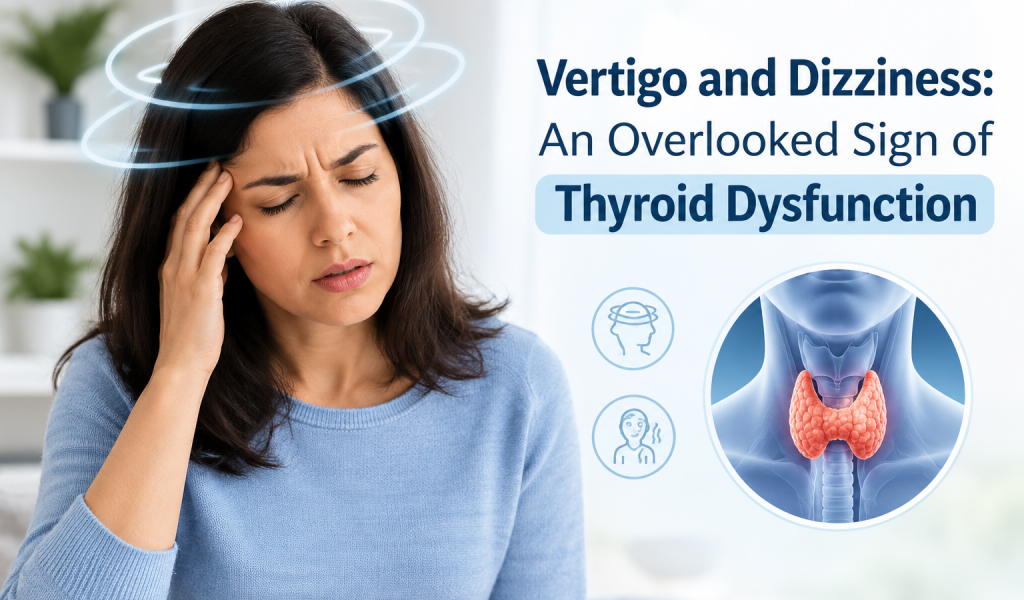
Dizziness and vertigo may be caused by inner-ear disorders, blood-pressure changes, cerebellar disorders and lastly, by hypothyroidism which is commonly overlooked by mainstream medicine.
Hypothyroidism contributes to lightheadedness or balance problems through myxedematous changes in the inner ear. Myxedema is one of the hallmarks of hypothyroidism, a peculiar gelatinous infiltration of soft tissues causing a puffy look to the face. This myxedema can infiltrate other tissues such as the inner ear which controls balance, thus causing vertigo and dizziness. The connection is real for selected hypothyroid patients, though true spinning vertigo is most suggestive for an inner ear problem called Ménière’s disease (BPPV) . Recognizing the full symptom picture and performing appropriate testing helps separate hormone-related from purely vestibular (inner ear) causes. (1)
What is BPPV (benign paroxysmal positional vertigo)?
BPPV (benign paroxysmal positional vertigo) is the most common cause of peripheral (inner-ear) vertigo, and best evaluated by the ENT doctor (Ear, Nose and Throat). Small calcium-carbonate crystals (otoconia) that normally sit in the utricle become dislodged and float into one of the semicircular canals (most often the posterior canal). When the head moves in certain ways, the crystals shift and produce a false spinning signal. Symptoms include brief episodes of spinning vertigo triggered by specific position changes (rolling over in bed, looking up, lying down, or tilting the head). There is no hearing loss, tinnitus, or constant symptoms between episodes.
The diagnosis is made by the ENT doctor with the Dix-Hallpike maneuver (or supine roll test for horizontal canal). A positive test produces characteristic torsional nystagmus and brief vertigo. Imaging or labs are not needed for straightforward cases. Treatment involves the Epley maneuver for posterior canal BPPV. This moves the crystals back into the utricle. Most patients improve with one or a few maneuvers. Recurrence is common; some people benefit from vestibular rehabilitation or home exercises. Medications are rarely useful for the vertigo itself. (12-16)
What is the Relationship of Vertigo to Hypothyroidism?
A 2024 meta-analysis by Dr. Cyntia Lima showed association of vertigo and dizziness with Hashimoto’s thyroiditis (autoimmune thyroid disease) in some subgroup analyses. Other studies link thyroid disorders such as goiter, hypothyroidism, and positive anti-thyroid antibodies with higher rates of vertigo and dizziness. In addition to hypothyroidism, proposed mechanisms include autoimmunity affecting the inner ear, altered otoconia metabolism, or shared risk factors (age, osteoporosis, vitamin D deficiency).
Brief, position-triggered spinning is classic for BPPV and initial evaluation with the ENT doctor and treated with head and neck positional maneuvers first. Thyroid testing is reasonable if classic hypothyroid or Hashimoto’s features are also present, but BPPV is not primarily a thyroid disease and usually does not resolve simply by correcting thyroid levels. (7-11)
Can an Underactive Thyroid Cause Vertigo and Dizziness?
Yes, it can. Hashimoto’s thyroiditis is an autoimmune condition, and the most common cause of hypothyroidism in the United States. How does hypothyroidism cause vertigo and dizziness? Thyroid hormone regulates fluid balance in the inner ear. When thyroid hormone is low, myxedema mucin, a gelatinous substance, accumulates in connective tissues, including the inner ear causing dysfunction of the inner ear which controls balance. This is associated with swelling and stiffness of neck muscles, closely related to head position and balance. Additionally, thyroid hormone also regulates heart rate, blood pressure regulation, energy production in mitochondria. This explains why hypothyroidism can cause slowing heart rate (bradycardia), reduced cardiac output, and dropping blood pressure upon standing, orthostatic hypotension which can produce lightheadedness. (1, 2)
Hypothyroid symptoms often arrive gradually over time. Thus it may be difficult to know if fatigue and sluggishness is related to aging, stress or hypothyroidism. Vertigo and dizziness may be the thyroid symptom that finally prompts medical evaluation. We may find the answer by reviewing the entire clinical pattern, basal body temperature, delayed reflexes, puffy face, dry skin, constipation, weight changes, and brain fog. These are the signs and symptoms of hypothyroidism.
For patients with Hashimoto’s disease, stress may trigger Hashimoto’s flare-ups called Hashitoxicosis.
Animal Studies of Hypothyroidism
In 2026, Dr. Gizem Meral Kantarci studied thyroidectomized rats with severe hypothyroidism. These hypothyroid animals quickly develop endolymphatic hydrops (fluid buildup) across multiple inner-ear structures, with membrane and hair-cell changes. The authors concluded that thyroid hormone deficiency in animal models can induce pathologic changes in the inner ear that explains the vestibular symptoms of vertigo and dizziness in hypothyroidism. (1)
How Does Thyroid-Related Dizziness Feel?
These symptoms feel like lightheadedness, unsteadiness, or a foggy head. True spinning (vertigo) is most suggestive for an inner ear problem, thus providing an important diagnostic distinction. Dizziness with classic hypothyroid signs and symptoms, constant tiredness, cold intolerance, dry skin, constipation, weight gain, or slowed thinking, deserves a full thyroid evaluation that goes beyond TSH alone. Our panel includes TSH, Free T3, FreeT4, reverse T3 and antithyroid antibodies.
Brief spinning triggered by rolling over in bed or tilting the head back is most suggestive for BPPV. Other symptoms such as ringing or ear fullness suggest Ménière’s disease. Initial evaluation of the inner ear by an ENT specialist should be done. However, hypothyroidism is frequently overlooked as the cause of vertigo and dizziness. Thyroid testing is useful, especially when other hypothyroid features are present. Provide your doctor with a short symptom diary and a complete list of medications and supplements before the appointment. Bring this list of every medication and supplement you take.
Ménière’s Disease and Hypothyroidism
In 2016, Dr. U. P. Santosh reported that 12 of 35 patients with Ménière’s disease (vertigo) also had hypothyroidism (approximately 34 %). All twelve received thyroid hormone replacement in addition to usual care. After 12 weeks every patient reported improvement in symptoms; vertigo scores fell from an average of 1.42 to 0.5. (4)
What Else Can Cause Dizziness That Looks Like Thyroid Trouble?
BPPV (benign paroxysmal positional vertigo) is the most common cause of peripheral vertigo. Initial evaluation of the inner ear by the ENT specialist is usually done. Blood-pressure changes, blood-sugar swings, dehydration, anemia, and medication side effects are also common. Levothyroxine itself can be associated with dizziness, either from an excessive dose producing a racing heart and lightheadedness or from an inadequate dose leaving residual hypothyroid symptoms. Orthostatic blood-pressure checks and routine labs help sort these out. A thyroid laboratory result should never be read in isolation. For more on this topic see our article on why you may still feel tired on levothyroxine and the article on the reverse T3 syndrome.
Don’t forget that blood sugar may play a role in dizziness and vertigo. Hypothyroidism can affect blood sugar control, with hypoglycemic episodes leaving you shaky and lightheaded.
How Do We Find Out Whether the Thyroid Is Involved?
Our routine thyroid laboratory panel includes TSH, Free T4, free T3, reverse T3, and thyroid antibodies. We interpret laboratory results in relation to symptoms, physical findings (including basal body temperature and reflexes), and the clinical picture. A normal TSH does not always exclude clinically significant hypothyroidism, especially the form Dr. Mark Starr calls Type 2 hypothyroidism. What is type two hypothyroidism? This is a problem with cellular utilization of thyroid hormone, even though circulating thyroid hormone levels are normal on standard thyroid laboratory testing.
We treat thyroid disorders such as Hashimoto’s and Graves’ disease, with lab testing through Quest and Labcorp, as described on our services page. Hypothyroidism treatment usually entails replacing the missing hormone, and doses are adjusted over time. We track symptoms such as dizziness, fatigue, and cold intolerance as the thyroid dosage changes. Retesting every six weeks or so is useful for adjusting thyroid dosage, as discussed in this article on how often we check thyroid levels.
Treatment involves replacing the missing thyroid hormone. Many patients do better with natural desiccated thyroid (NDT, containing both T4 and T3). In my opinion, NDT is more robust and provides superior results when compared to T4-only levothyroxine. Doses are adjusted according to symptoms and clinical signs as well as labs. For more on this topic, see Dr. Dach’s book on thyroid, Natural Thyroid Toolkit.
In 2020, Dr. So Young Kim and colleagues, in a large nested case-control study, found higher rates of goiter, hypothyroidism, and hyperthyroidism among patients with Ménière’s disease. (2)
In 2025, Dr. Rui Lai and colleagues published a systematic review and meta-analysis of 18 studies. They reported a pooled prevalence of thyroid disease in Ménière’s disease of about 8% and noted that thyroid hormone treatment improved both hypothyroid symptoms and Ménière’s symptoms. (3)
Which Dizziness Symptoms Need Emergency Care?
Sudden severe headache, weakness or numbness on one side, trouble speaking, vision loss, chest pain, or fainting require emergency care, not a thyroid appointment. Call your local emergency number (911) immediately.
What Should You Do Next?
After initial evaluation by the ENT specialist fails to provide relief for vertigo and dizziness, one might then consider another commonly overlooked cause, hypothyroidism. If you are having recurring episodes of vertigo and dizziness, associated with fatigue, cold intolerance, or other thyroid symptoms, a full thyroid evaluation and treatment with NDT could be useful, especially if previous T4-only therapy gave incomplete relief.
Conclusion:
Vertigo and dizziness can be overlooked manifestations of hypothyroidism, particularly when myxedema and inner-ear fluid imbalance are involved. Correcting thyroid status, often more effectively with combination T3/T4 found in natural desiccated thyroid (NDT), can improve symptoms in selected patients. This is supported by observational and experimental data. Of course, the initial step is to rule out other causes with inner-ear evaluation by the ENT specialist.
For unresolved symptoms of vertigo and dizziness, especially if there are associated hypothyroid symptoms, we are here to help. Feel free to contact Jeffrey Dach MD at our TruemedMD office in Davie, Florida for a full thyroid evaluation.
Articles with Related Interest:
Vertigo, Dizziness and Hypothyroidism
Hashimoto’s Autoimmune Thyroid Disease and Molecular Mimicry
TSH Basics, How to Interpret the TSH
All Thyroid Related Articles by Jeffrey Dach MD
References:
1. Kantarci, G. M., et al. “Thyroid Hormone Deficiency Induces Endolymphatic Hydrops: Neurological and Histopathological Evidence from an Experimental Rat Model.” Frontiers in Neurology, vol. 17, 2026, article 1774666. https://www.frontiersin.org/journals/neurology/articles/10.3389/fneur.2026.1774666/full.
2. Kim, So Young, et al. “Association between Ménière’s Disease and Thyroid Diseases: A Nested Case–Control Study.” Scientific Reports, vol. 10, 2020, article 18224. https://www.nature.com/articles/s41598-020-75404-y.
3. Lai, Rui, et al. “Association Between Ménière’s Disease and Thyroid Disease: A Systematic Review and Meta-Analysis.” Clinical Otolaryngology, vol. 50, no. 4, 2025, pp. 633–43. https://onlinelibrary.wiley.com/doi/10.1111/coa.14308.
4. Santosh, U. P., and M. S. Sudhakar Rao. “Incidence of Hypothyroidism in Meniere’s Disease.” Journal of Clinical and Diagnostic Research, vol. 10, no. 5, May 2016, pp. MC01–MC03. https://pmc.ncbi.nlm.nih.gov/articles/PMC4948427/.
5. Starr, Mark. Hypothyroidism Type 2: The Epidemic. Mark Starr Trust, 2005
6. Barnes, Broda O., and Lawrence Galton. *Hypothyroidism: The Unsuspected Illness*. Harper & Row, 1976.
7) Lima, Cyntia Machado, et al. “Association between Benign Paroxysmal Positional Vertigo and Thyroid Diseases: Systematic Review and Meta-Analysis.” International Archives of Otorhinolaryngology, vol. 28, no. 3, 2024, pp. e530–e536. https://doi.org/10.1055/s-0043-1769496.
8) Choi, Hyo Geun, et al. “Analyses of the Relation between BPPV and Thyroid Diseases: A Nested Case-Control Study.” Diagnostics, vol. 11, no. 2, 2021, article 329. https://www.mdpi.com/2075-4418/11/2/329.
9) Tricarico, Laura, et al. “Benign Paroxysmal Positional Vertigo: Is Hypothyroidism a Risk Factor for Recurrence?” Acta Otorhinolaryngologica Italica, vol. 42, no. 5, 2022, pp. 465–70. https://doi.org/10.14639/0392-100X-N1775.
10) Papi, Giampaolo, et al. “Association between Benign Paroxysmal Positional Vertigo and Autoimmune Chronic Thyroiditis.” Clinical Endocrinology, vol. 70, no. 1, 2009, pp. 169–70. https://doi.org/10.1111/j.1365-2265.2008.03311.x.
11) Papi, Giampaolo, et al. “The Association Between Benign Paroxysmal Positional Vertigo and Autoimmune Chronic Thyroiditis Is Not Related to Thyroid Status.” Thyroid, vol. 20, no. 2, 2010, pp. 237–38. https://doi.org/10.1089/thy.2009.0319.
12) Bhattacharyya, Neil, et al. “Clinical Practice Guideline: Benign Paroxysmal Positional Vertigo (Update).” Otolaryngology–Head and Neck Surgery, vol. 156, no. 3_suppl, 2017, pp. S1–S47. https://doi.org/10.1177/0194599816689667.
13) Hilton, Malcolm P., and Darren K. Pinder. “The Epley (Canalith Repositioning) Manoeuvre for Benign Paroxysmal Positional Vertigo.” Cochrane Database of Systematic Reviews, 2014, no. 12, article CD003162. https://www.cochrane.org/evidence/CD003162_epley-manoeuvre-benign-paroxysmal-positional-vertigo-bppv.
14) Edlow, Jonathan A., et al. “Guidelines for Reasonable and Appropriate Care in the Emergency Department 3 (GRACE-3): Acute Dizziness and Vertigo in the Emergency Department.” Academic Emergency Medicine, vol. 30, no. 5, 2023, pp. 442–86. https://doi.org/10.1111/acem.14728.
15) Sharif, Sameer, et al. “Vestibular Suppressants for Benign Paroxysmal Positional Vertigo: A Systematic Review and Meta-Analysis of Randomized Controlled Trials.” Academic Emergency Medicine, vol. 30, no. 5, 2023, pp. 541–51. https://doi.org/10.1111/acem.14608.
16) NICE Clinical Knowledge Summary. “Benign Paroxysmal Positional Vertigo: Diagnosis.” National Institute for Health and Care Excellence, https://cks.nice.org.uk/topics/benign-paroxysmal-positional-vertigo/diagnosis/diagnosis/. Accessed 2026.