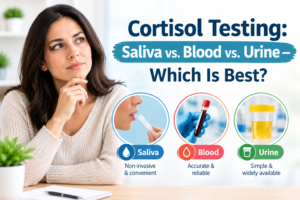
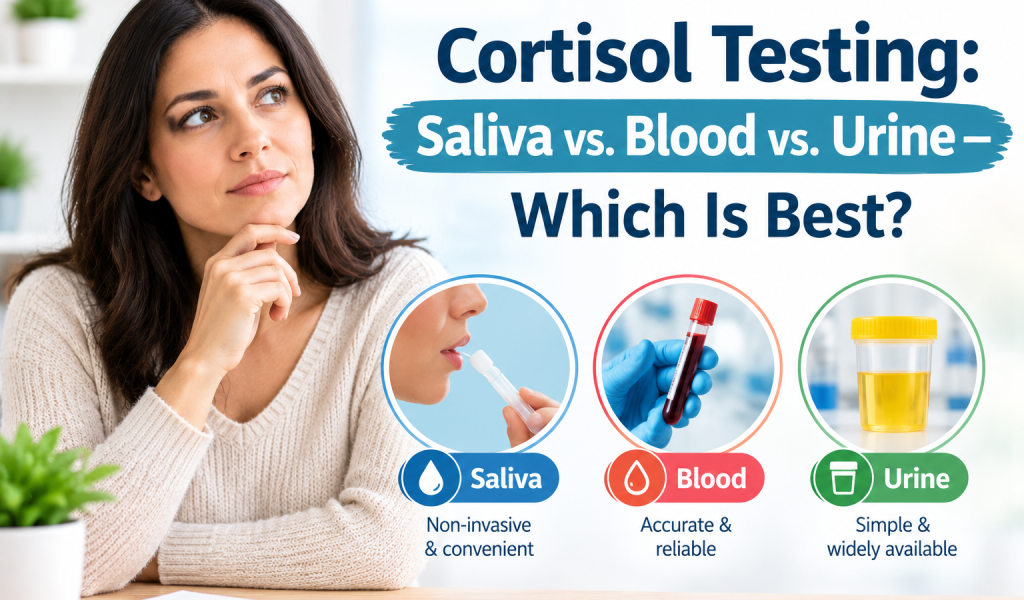
Cortisol testing methods differ by the type of information they capture. A single blood draw shows a snapshot of serum cortisol at one moment in time. A series of four saliva samples provides a map of daily cortisol rhythm, normally high in the AM and low in the PM. A 24-hour urine collection provides the entire day of free cortisol output. Each method has its uses. And, no single method is best for every clinical question. The test chosen depends on the clinical concern. We will concentrate on three clinical concerns.
1) Excess cortisol, as in Cushing syndrome.
2) Cortisol deficiency, as in adrenal insufficiency.
3) Altered diurnal pattern of cortisol associated with fatigue or chronic stress.
We will examine each clinical concern and testing choice in more detail below.
Salivary Cortisol is Appropriate Clinical measurement
In 1983, Dr. Ross F. Vining and colleagues demonstrated that salivary cortisol is directly proportional to the unbound (free) fraction of serum cortisol and equilibrates rapidly with blood. They concluded that salivary measurement is a more appropriate clinical measure of adrenocortical function than serum total cortisol because it is unaffected by changes in cortisol-binding globulin and is collected without the stress of venipuncture. This foundational observation remains relevant today. Salivary cortisol is a very good and extremely useful test, especially for altered diurnal patterns found in chronic fatigue. (1)
When is Blood Cortisol Drawn?
Blood cortisol is typically drawn in the morning (peak) and sometimes again in the late afternoon. It is useful as a starting point for suspected cortisol deficiency and is required for the ACTH stimulation test which uses two cortisol measurements, one before and one after an ACTH injection. However, total serum cortisol is influenced by binding proteins (cortisol binding globulin). Oral contraceptives and pregnancy raise cortisol-binding globulin and can elevate the total value without a corresponding rise in free hormone. Stress at the moment of the blood draw can also transiently elevate the cortisol result. (1) (4-6)
Why is Saliva Sampling Best?
Saliva sampling allows multiple collections at home. A four-point profile (commonly morning, noon, late afternoon, and bedtime) shows the expected diurnal decline, meaning that the normal daily cortisol pattern shows highest values in the morning and lowest values at night. Late-night salivary cortisol is an accepted screening test for Cushing syndrome because loss of the evening trough (lowest value in evening) is an early finding. In my practice and in the articles I have written on adrenal fatigue and HPA dysfunction, the four-sample salivary cortisol curve is the method I find most useful for evaluating patients with fatigue, stress intolerance, and related symptoms. It is convenient, reflects free hormone levels, and captures daily rhythm rather than a single snapshot in time.
Mainstream endocrinology does not recognize adrenal fatigue as a bona fide diagnosis. However, we take adrenal fatigue seriously as described in more detail below.
In 2008, Dr. Urs M. Nater and colleagues reported that individuals with chronic fatigue syndrome showed lower morning salivary cortisol and a flattened diurnal profile compared with controls. Similar alterations in the cortisol awakening response and daily rhythm have been described in various stress-related and fatigue states. These abnormal cortisol patterns can be documented with multi-point salivary testing even when a single morning blood cortisol is completely normal. (2)
For more on this topic see: Adrenal Fatigue by Jeffrey Dach MD and Adrenal Insufficiency, HPA Dysfunction and Fatigue.
24 Hour Urine Collection for Free Cortisol
A 24-hour urine free cortisol collection measures integrated daily free cortisol excretion. It is one of the standard screening tests for Cushing syndrome, along with late-night salivary cortisol and the low-dose dexamethasone suppression test. Completeness of collection is critical. Incomplete collections produce falsely low results. A single morning urine sample is not a substitute for the full 24-hour collection when excess is the question. (7)
ACTH Stimulation Test
For suspected adrenal insufficiency, the ACTH stimulation test, using serum cortisol, remains the gold standard test to assess adrenal reserve. A morning serum cortisol can serve as an initial screen. Multi-point salivary testing is not used to diagnose primary or secondary adrenal insufficiency. It is used to characterize diurnal patterns in patients who do not meet criteria for frank insufficiency. (8-12)
Adrenal Fatigue
As mentioned above, “Adrenal Fatigue” is not a recognized endocrine diagnosis. In 2016, Dr. Flávio A. Cadegiani and Dr. Claudio E. Kater published a systematic review concluding that the term lacks substantiation as a distinct medical entity. At the same time, altered cortisol rhythms (flattening, low morning values, elevated evening values) are repeatedly observed in clinical studies of chronic stress, chronic fatigue, and related conditions. In my 2023 article “Adrenal Insufficiency, HPA Dysfunction and Fatigue,” I discuss this distinction: conventional provocative tests diagnose disease, while functional salivary profiles identify subclinical HPA dysregulation patterns that may still be clinically relevant. Physical findings such as orthostatic changes and an unstable pupil, together with the clinical history, remain important. Although still debated by mainstream endocrinology, we take adrenal fatigue seriously. (3)
What Can Throw Off Your Results?
Long-term steroid use, or stopping steroids suddenly, is the most common cause of abnormal levels. Stress, exercise, pregnancy, extreme temperatures, and birth control pills can also shift results. Tell your provider about all medicines, including skin creams, nasal sprays, and never stop a steroid suddenly without medical advice. Patients on high dose steroids, usually prednisone or hydrocortisone, who suddenly stop the steroid drug will experience a medical emergency called adrenal crisis. Needless to say, this is not a good thing and is best avoided.
Depression, anxiety, alcohol use disorder, poorly controlled diabetes and obesity can raise cortisol without true Cushing syndrome. Supplements may affect cortisol. Our guide to evidence-based thyroid supplements notes that ashwagandha can affect stress hormones.
Chronic stress itself changes cortisol patterns, as explored in how stress affects Hashimoto’s flare-ups.
Factors that can alter results include exogenous glucocorticoids (oral, topical, inhaled, or injected steroids), oral contraceptives, pregnancy, acute stress, vigorous exercise, recent meals, and poor collection technique. Medications and supplements should be reviewed before testing. Ashwagandha and other adaptogens can influence HPA activity. (13-16)
Cortisol Testing- Practical Considerations
In practice, the decision starts with the clinical question being answered. For suspected Cushing syndrome, late-night salivary cortisol, 24-hour urine free cortisol, and dexamethasone suppression testing are used in combination. For suspected adrenal insufficiency, morning serum cortisol followed by ACTH stimulation is standard. For patients with fatigue and stress-related symptoms who do not meet criteria for either extreme, a four-point salivary cortisol profile provides information about the diurnal rhythm that a single blood test cannot. Results are always interpreted in relation to medical history and clinical findings, including thyroid status, sleep, medications, and overall health. (17-18)
For stress-related symptoms and chronic stress, our article on hormone imbalances and anxiety describes testing with early morning serum cortisol or a four-sample salivary cortisol as useful in this scenario.
Is Adrenal Fatigue a Real Diagnosis?
Adrenal insufficiency is a real and recognized entity. Fatigue, low blood pressure, weight loss, and nausea deserve proper evaluation, and the ACTH stimulation test is the standard way to see whether the adrenal glands respond. If they respond normally, that argues against adrenal burnout. Vague symptoms still deserve careful evaluation, not dismissal. Fatigue often overlaps with thyroid problems, which our guide to adrenal fatigue vs. thyroid dysfunction helps sort this out. For further discussion of these topics, see my articles:
Adrenal Fatigue
Adrenal Insufficiency, HPA Dysfunction and Fatigue
Chapter 7: Adrenal Fatigue the Ignored Epidemic of Modern Civilization
Chronic Stress, Adverse Health Effects
What Should You Do Next?
As mentioned above, the cortisol test is selected based on clinical presentation. Initial evaluation includes a review of your medical history, medication list, physical examination and full laboratory panel as described on our services page.
Tell your clinician about your medications and supplements. Some find it useful to bring a list of symptoms, timing, and any associated steroid use which includes over the counter steroid skin creams and nasal sprays. Review the patient checklist for hormone testing which covers testing preparations.
If you are experiencing unexplained fatigue, poor sleep, or chronic stress, feel free to contact our medical director, Jeffrey Dach MD at the TruemedMD clinic in Davie, Florida to discuss a complete evaluation and treatment plan.
Frequently Asked Questions
Which cortisol testing method is most accurate?
Accuracy depends on the question being answered. Late-night saliva and 24-hour urine free cortisol are established for excess (Cushing’s Syndrome). Morning serum cortisol plus ACTH stimulation is standard for adrenal deficiency. Multi-point saliva is useful for diurnal rhythm.
Can stress change results?
Yes. Acute stress elevates cortisol. Rest before blood draws and follow collection instructions for saliva.
Do birth control pills affect tests?
Yes. They raise cortisol-binding globulin and can elevate total serum cortisol. Salivary free cortisol is less affected.
How do I prepare for a saliva test?
Avoid food, drink, brushing, and flossing for 30 minutes before each collection. Collect at the specified times.
Is the 24-hour urine collection difficult?
It requires care. Discard the first morning void, collect all subsequent urine for 24 hours, keep the container cool, and return the complete specimen.
What do these cortisol tests screen for?
Primarily Cushing syndrome (excess) and adrenal insufficiency (deficiency). Diurnal salivary profiles also document rhythm abnormalities seen in chronic stress and fatigue states.
Can a cortisol test diagnose adrenal fatigue?
Although mainstream endocrinology does not recognize adrenal fatigue as a bona fide medical diagnosis, we take it seriously. Testing can identify Cushing syndrome, adrenal insufficiency. On salivary cortisol testing, an abnormal diurnal pattern can be recognized that suggests adrenal fatigue. This is to be taken seriously and warrants further clinical evaluation.
Articles with Related Interest:
1. Adrenal Fatigue by Jeffrey Dach MD
2. Adrenal Insufficiency, HPA Dysfunction and Fatigue
3. Chapter 7: Adrenal Fatigue the Ignored Epidemic of Modern Civilization
4. Chronic Stress, Adverse Health Effects
References:
1. Vining, Ross F., et al. “Salivary Cortisol: A Better Measure of Adrenal Cortical Function than Serum Cortisol.” Annals of Clinical Biochemistry, vol. 20, no. 6, 1983, pp. 329–35. https://doi.org/10.1177/000456328302000601.
2. Nater, Urs M., et al. “Alterations in Diurnal Salivary Cortisol Rhythm in a Population-Based Sample of Cases with Chronic Fatigue Syndrome.” Psychosomatic Medicine, vol. 70, no. 3, 2008, pp. 298–305. https://doi.org/10.1097/PSY.0b013e3181651025.
3. Cadegiani, Flávio A., and Claudio E. Kater. “Adrenal Fatigue Does Not Exist: A Systematic Review.” BMC Endocrine Disorders, vol. 16, 2016, article 48. https://doi.org/10.1186/s12902-016-0128-4.
4. Bornstein, Stefan R., et al. “Diagnosis and Treatment of Primary Adrenal Insufficiency: An Endocrine Society Clinical Practice Guideline.” Journal of Clinical Endocrinology & Metabolism, vol. 101, no. 2, 2016, pp. 364–89. https://doi.org/10.1210/jc.2015-1710.
5. Brien, T. G. “Cortisol metabolism after oral contraceptives: total plasma cortisol and the free cortisol index.” BJOG: An International Journal of Obstetrics & Gynaecology 82.12 (1975): 987-991.
6. MedlinePlus. “ACTH Stimulation Test.” https://medlineplus.gov/ency/article/003696.htm.
7. Nieman, Lynnette K., et al. “The Diagnosis of Cushing’s Syndrome: An Endocrine Society Clinical Practice Guideline.” *Journal of Clinical Endocrinology & Metabolism*, vol. 93, no. 5, 2008, pp. 1526–40. https://doi.org/10.1210/jc.2008-0125.
8. UpToDate. “Diagnosis of adrenal insufficiency in adults.” https://www.uptodate.com/contents/diagnosis-of-adrenal-insufficiency-in-adults.
9. Endocrine Society. “Primary Adrenal Insufficiency Guideline Resources.” https://www.endocrine.org/clinical-practice-guidelines/primary-adrenal-insufficiency.
10. NICE CKS. “Investigations – suspected adrenal insufficiency.” https://cks.nice.org.uk/topics/addisons-disease/diagnosis/investigations-suspected-adrenal-insufficiency/.
11. Raff, Hershel. “Utility of Salivary Cortisol Measurements in Cushing’s Syndrome and Adrenal Insufficiency.” Journal of Clinical Endocrinology & Metabolism, vol. 94, no. 10, 2009, pp. 3647–55. https://doi.org/10.1210/jc.2009-1166.
12. Endocrine Society. “Adrenal Insufficiency.” https://www.endocrine.org/patient-engagement/endocrine-library/adrenal-insufficiency.
13. Beuschlein, Felix, et al. “European Society of Endocrinology and Endocrine Society Joint Clinical Guideline: Diagnosis and Therapy of Glucocorticoid-Induced Adrenal Insufficiency.” European Journal of Endocrinology, vol. 190, no. 5, 2024, pp. G25–G51. https://doi.org/10.1093/ejendo/lvae029.
14. Lopresti, Adrian L., et al. “An Investigation into the Stress-Relieving and Pharmacological Actions of an Ashwagandha (Withania somnifera) Extract: A Randomized, Double-Blind, Placebo-Controlled Study.” Medicine, vol. 98, no. 37, 2019, e17186. https://doi.org/10.1097/MD.0000000000017186.
15. Della Porta, Matteo, et al. “Effects of Withania somnifera on Cortisol Levels in Stressed Human Subjects: A Systematic Review.” Nutrients, vol. 15, no. 24, 2023, article 5015. https://doi.org/10.3390/nu15245015.
16. Pandit, S., et al. “Effects of Withania somnifera Extract in Chronically Stressed Adults: A Randomized Controlled Trial.” Nutrients, vol. 16, no. 9, 2024, article 1293. https://doi.org/10.3390/nu16091293.
17. StatPearls. “Adrenocorticotropic Hormone (Cosyntropin) Stimulation Test.” https://www.ncbi.nlm.nih.gov/books/NBK555940/.
18. Kumari, Meena, et al. “Cortisol Secretion and Fatigue: Associations in a Community Based Cohort.” *Psychoneuroendocrinology*, vol. 34, no. 10, 2009, pp. 1476–85. https://doi.org/10.1016/j.psyneuen.2009.05.001.