What Is Subclinical Hypothyroidism?
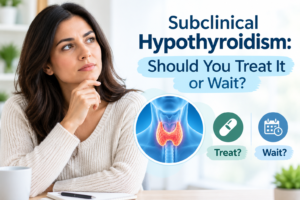
Subclinical hypothyroidism is defined as an elevated TSH with a normal free T4. The prevalence is about 4.3 percent in the US population aged 12 and older, and closer to 15 percent in adults 65 and older. In 2025, Dr. Rishing Xu reviewed thyroid treatment of elderly patients with subclinical hypothyroidism, advising against treatment and advocating for a wait and see approach. Dr Xu writes:
Whether subclinical hypothyroidism should be treated in elderly patients (≥ 65 years) is controversial. The authors argue for a personalized, wait-and-see approach rather than universal treatment, pointing out that randomized clinical trials have not shown that levothyroxine treatment makes any difference in terms of hard clinical end points, quality of life, or hypothyroid symptom relief in elderly patients with this condition. (4)
The decision to treat the elevated TSH or observe the patient is not based on a single TSH laboratory value. Age, symptoms, antibody status, free hormone levels, and the overall clinical picture all matter when deciding whether to treat subclinical hypothyroidism or simply watch and wait. Mainstream guidelines suggest observation for mild TSH elevations, especially in older adults. In my practice and in the articles I have written on this topic, the approach is more proactive when antibodies are elevated or symptoms are present. You will see below, the presence of elevated TPO and TgAb anti-thyroid antibodies triggers early treatment.
In 2013, Dr. Simon Pearce published the European Thyroid Association guideline on subclinical hypothyroidism. Dr Simon Pearce recommended against treatment. Instead the TSH and free T4 (plus TPO antibodies) should be repeated at 3 months intervals before deciding on treatment. For younger patients with TSH elevation above 10 mIU/L, thyroid hormone replacement is generally advised even without symptoms. For milder elevations with symptoms, a trial of levothyroxine can be considered and stopped if there is no benefit. (1).
The 2017 TRUST trial by Dr. David J. Stott and colleagues randomized 737 adults aged 65 and older with persistent subclinical hypothyroidism (TSH 4.6–19.99 mIU/L, normal free T4) to levothyroxine or placebo. At one year, TSH fell with treatment, but hypothyroid symptom scores and tiredness scores did not improve compared with placebo. These data support a cautious approach in older adults without clear symptoms. (2)
Spontaneous Normalization of TSH
Spontaneous normalization of TSH is common. In large cohorts of older adults, TSH returned to the normal reference range in roughly 40–60 percent of patients within one to three years, especially when the initial elevation was mild, TPO antibodies were negative, and free T4 was higher in the normal range. Treating a TSH value that may correct itself is unnecessary. This is why confirmation with a second (and sometimes third) set of TSH labs is standard. A repeat panel should also include TPO antibodies. We outline our usual testing schedule here: how often we check thyroid levels. (3)
Presence of Anti-Thyroid Antibodies
The presence of anti-thyroid antibodies changes the discussion. In my 2022 article “Hashimoto’s Thyroiditis with Normal TSH, When to Treat? ,” I reviewed evidence that euthyroid patients with elevated TPO or thyroglobulin antibodies benefit from early thyroid hormone. Pediatric studies show that starting levothyroxine can stabilize the autoimmune process and reduce thyroid gland volume even when TSH is still normal. Waiting until TSH rises means allowing progressive damage. The same principle applies in adults with clear Hashimoto’s and symptoms. My 2015 article on TSH suppression notes that many endocrinologists already treat “euthyroid” Hashimoto’s patients with thyroxine to lower antibody titers.
The Unreliable TSH
The upper limit of the TSH reference range itself is debated. In my 2013 article “The TSH Reference Range Wars – Part One,” I summarized data from Dr. Wartofsky and others showing that more than 95 percent of healthy individuals have TSH below 2.5 mIU/L. Values between 2.5 and 4.5 often represent early thyroid failure, especially when antibodies are present. Relying on the traditional 0.4–4.5 range delays recognition and treatment. My articles on the unreliable TSH test and on Antonio Bianco’s work further explain why TSH alone is a poor guide for deciding whether a patient needs thyroid hormone or for judging the adequacy of treatment. Free T3, free T4, reverse T3, and clinical status provide better information.
Natural Desiccated Thyroid is Better
When treatment is started, natural desiccated thyroid (NDT) containing both T3 and T4 is preferred over levothyroxine alone for many patients. Residual symptoms on T4-only therapy are well documented even when TSH is “normalized.” Adding selenium, optimizing vitamin D, and using a gluten-free diet when reactivity is present further address the autoimmune component, as discussed in my articles on selenium, myo-inositol, and addressing the autoimmune component of thyroid disease. Myo-inositol plus selenium has been shown in Nordio’s trials to lower TSH and antibodies in subclinical Hashimoto’s cases with TSH in the 3–6 range.
Subclinical Hypothyroidism and Cardiovascular Disease
Cardiovascular data are mixed. The Razvi 2012 cohort found that levothyroxine treatment of subclinical hypothyroidism was associated with fewer ischemic heart disease events in younger patients but not in those over 70. Overtreatment that suppresses TSH is linked to atrial fibrillation and in hyperthyroid cases, bone loss, so monitoring free T3 and Free T4 levels and clinical status is essential. Low starting doses and slow titration are appropriate in older adults with heart disease. For more on this topic see: Thyroid Pills Prevent Heart Attacks .
In 2012, Dr. Salman Razvi writes:
Treatment of SCH with levothyroxine was associated with fewer IHD (ischemic heart disease) events in younger individuals,(40-70) but this was not evident in older people(<70yrs). (5)
These clinical scenarios tip the balance toward treating subclinical hypothyroidism:
- TSH above 10 on repeat testing
- A TSH that keeps rising between tests
- Positive TPO antibodies with symptoms or other risk factors
- Definite symptoms such as fatigue, cold intolerance, or constipation
- Pregnancy or pregnancy planning, which calls for prompt medical guidance
In summary, mild TSH elevations without elevated anti-thyroid antibodies or thyroid symptoms in older adults are best followed with observation. Persistent elevations of TSH above 10, positive antibodies with symptoms, progressive rises in TSH, pregnancy, or clear hypothyroid features favor treatment. The decision rests on the full clinical pattern, not a single TSH lab value. For related discussions, see my articles listed below.
We are here to help. If you have an elevated TSH and you are interested in our program, feel free to contact Jeffrey Dach MD and the TruemedMD office in Davie to schedule a consultation with our team.
Frequently Asked Questions
Do I need treatment if I have no symptoms?
Not always. Mild elevations without antibodies or symptoms, especially in older adults, are often monitored after confirmation.
Can subclinical hypothyroidism go away on its own?
Yes, in a substantial fraction of cases, particularly when TSH is only mildly elevated and antibodies are negative.
What TSH level usually triggers treatment?
Above 10 mIU/L is the most common threshold in guidelines. Below that, antibodies, symptoms, age, and progression matter.
Does levothyroxine help older adults with mild cases?
In the TRUST trial of adults ≥65 years, it lowered TSH but did not improve symptom or tiredness scores at 12 months.
Can too much thyroid hormone cause problems?
Yes. Persistent TSH suppression is associated with atrial fibrillation. In patients with TSH suppression and exogenous hyperthyroidism, there may be bone loss. Monitoring free hormone levels and clinical status is advised.
How often should TSH be rechecked?
If untreated and mild, recheck in 2–3 months, then periodically. Once stable on treatment, every 6–12 months is typical.
Articles with Related Interest
Hashimoto’s Thyroiditis with Normal TSH, When to Treat?
MyoInositol for Hashimotos Part Two
TSH Suppression Benefits and Adverse Effects
The TSH Reference Range Wars – Part One
Antonio Bianco TSH Inadequate for Thyroid Dosing
Errors in Modern Thyroid Endocrinology
Unexplained Infertility Linked to Low Thyroid Function
Thyroid Pills Prevent Heart Attacks
References
1. Pearce, Simon H. S., et al. “2013 ETA Guideline: Management of Subclinical Hypothyroidism.” European Thyroid Journal, vol. 2, no. 4, 2013, pp. 215–28. https://doi.org/10.1159/000356507.
2. Stott, David J., et al. “Thyroid Hormone Therapy for Older Adults with Subclinical Hypothyroidism.” New England Journal of Medicine, vol. 376, no. 26, 2017, pp. 2534–44. https://doi.org/10.1056/NEJMoa1603825.
3. Du Puy, Robert S., et al. “Incidence and Determinants of Spontaneous Normalization of Subclinical Hypothyroidism in Older Adults.” Journal of Clinical Endocrinology & Metabolism, vol. 109, no. 3, 2024, e1167–e1174. https://doi.org/10.1210/clinem/dgad623
4. Xu, Risheng, et al. “Most elderly patients with subclinical hypothyroidism do not need to be treated.” Cleveland Clinic journal of medicine 92.4 (2025): 221.
5. Razvi, Salman, et al. “Levothyroxine treatment of subclinical hypothyroidism, fatal and nonfatal cardiovascular events, and mortality.” Archives of internal medicine 172.10 (2012): 811-817.