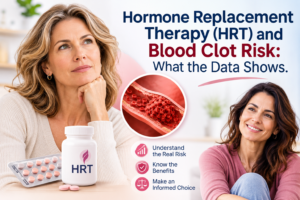
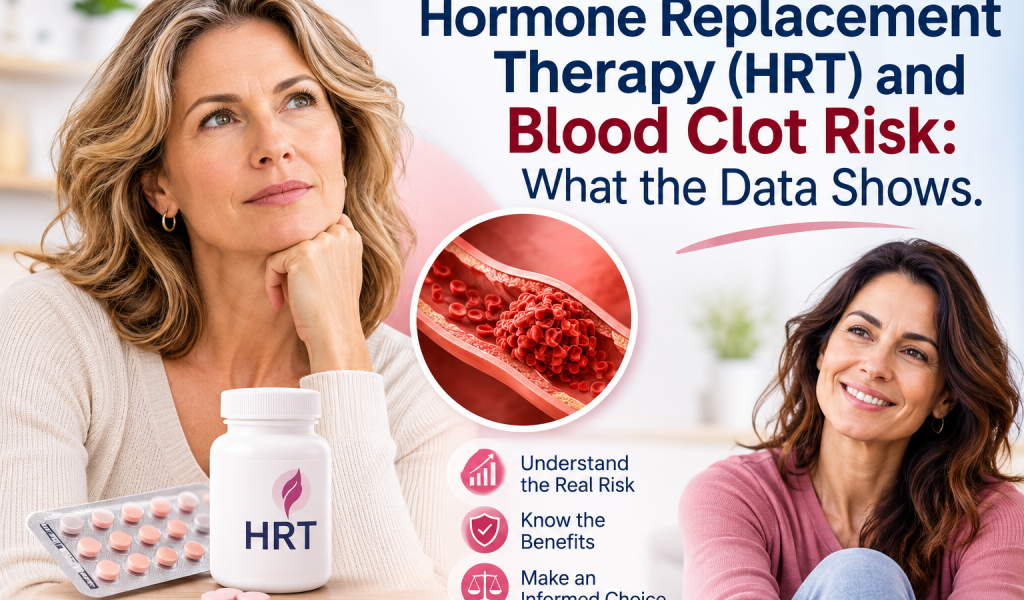
The warning label says estrogen causes blood clots. HRT blood clot risk is real, but it varies sharply by hormone type, how it is taken, and who is taking it. Medical research says blood clot formation depends on the route of estrogen delivery. Oral estrogen, taken by mouth, roughly doubles the risk of venous blood clots, yet the absolute risk stays small for most healthy women under 60. Topical estrogen absorbed through the skin, by patch or gel, has not shown the same increase in blood clot formation. The problem with blood clot formation arises when oral estrogen is used and when synthetic progestins are used. The take home message is that transdermal estrogen is safe and does not cause blood clots. Oral estrogen pills and synthetic progestin pills are associated with increased blood clots, venous thrombosis, pulmonary embolism and stroke. (1–3)
For more information on this topic, see my articles:
The Safety of Transdermal Estrogen
Transdermal vs Oral Estrogen Part Two,
Errors in Modern Medicine: The Fear of Estrogen
What the Big Trials Showed
In 2002, Dr. Jacques E. Rossouw and colleagues published the Women’s Health Initiative, a large randomized trial that found more venous clots among women taking oral combined therapy than among those on placebo. Most participants were in their sixties, older than the typical woman who starts treatment for symptoms. (1)
Later analyses and observational studies refined the picture. That context explains why HRT blood clot risk looks different in a 52-year-old than in a 70-year-old. In Errors in Modern Medicine: The Fear of Estrogen, I noted that the WHI used the wrong hormones (conjugated equine estrogen plus medroxyprogesterone acetate) in the wrong age group. The 18-year follow-up data further showed that estrogen alone reduced breast cancer mortality, while the addition of a synthetic progestin increased it. (4)
Why the Route Matters
Oral estrogen passes through the liver first, where it raises several clotting proteins. Skin delivery bypasses that first pass, so the effect on clotting is much smaller.
| Option | What studies suggest about clot risk |
| Oral estrogen | Higher risk of venous clots |
| Patch or gel estrogen | No increased risk for blood clots at standard doses |
| Micronized progesterone | No increase in observational data |
| Some synthetic progestins | Increased risk for blood clots. |
Much of the estrogen skin patch and progesterone evidence comes from observational studies, and not randomised controlled trials. However observational studies are still useful. In my article, Transdermal vs Oral Estrogen Part Two, I concluded there is overwhelming evidence that the transdermal route is safest with respect to venous thromboembolism, and that adding natural micronized progesterone does not increase that risk. (5, 6)
Absolute Risk Versus Relative Risk
A doubling sounds alarming. But clots are uncommon in healthy women in their fifties, so doubling a small number adds only a few extra cases per thousand women over time. The same doubling matters far more for a 68-year-old with obesity and a history of clots. The percentage is identical. The consequence is not. (1, 2)
Who Starts With Higher Risk
Your baseline matters more than the headline. Higher baseline risk comes with:
- A personal or family history of blood clots
- An inherited clotting disorder, such as factor V Leiden
- Obesity or smoking
- Recent surgery, injury, or long periods of immobility
- Starting hormone therapy well past menopause
Timing is part of the picture. Our article on the best time to start hormone replacement therapy after menopause explains why age and years since menopause shape the balance of benefit and risk. In Preventing Coronary Artery Disease with Bioidentical Hormones I emphasized the timing hypothesis of Drs. Howard Hodis and Wendy Mack: benefits are greatest when therapy begins near menopause. (1, 2, 7)
Questions That Shape the Decision
Before starting HRT, tell your clinician about any blood clot episodes in your own history or in close relatives. A strong family pattern may justify laboratory screening for thrombophilia, a genetic predisposition to blood clots. Ask whether a transdermal route, delivered to the skin, suits your symptoms. And of course, always ask for natural progesterone instead of synthetic progestins. Although both progesterone and synthetic progestins are FDA approved for prevention of endometrial hyperplasia, the synthetic progestins are associated with blood clots, while natural progesterone is not. Also ask what your own laboratory test numbers look like. Smoking, weight, blood pressure, and blood sugar all affect risk, and several are changeable. As I have written repeatedly, we avoid synthetic progestins such as medroxyprogesterone acetate. (8)
Lowering Your Odds While on Treatment
How do we reduce the risk of blood clots? Use the lowest dose of estrogen that controls symptoms. Stay active and avoid long stretches of sitting. Work toward a healthy weight and stop smoking. Before major surgery, inform your doctor if you are taking oral estrogen, as this increases risk for blood clots. On long flights, walk the aisle, flex your calves, and drink water. These habits help every traveler, and they matter more when other risk factors stack up.
Warning Signs That Need Urgent Care
Seek emergency care for any of these symptoms suggestive for blood clot formation: swelling, warmth, or pain in one leg; sudden shortness of breath; chest pain or a racing heartbeat with no clear cause; sudden severe headache or vision changes.
Estrogen Alone Versus Estrogen Plus Progestogen
Women who still have a uterus need progesterone alongside estrogen to protect the endometrium (uterine lining). Synthetic progestins are not recommended since they increase risk for blood clot formation and breast cancer. Although mainstream medicine dogmatically uses estrogen alone without progesterone for women after hysterectomy, in my office we also give estrogen with progesterone even after hysterectomy because progesterone has many other health benefits. As mentioned above, the combination of estrogen with synthetic progestin in major trials carried more clot risk than estrogen alone, reflecting the progestin used. Today, it is clear one should choose natural progesterone and avoid synthetic progestins. Make sure to ask your prescriber directly about this. In my article on Safety and Adverse Effects of Natural Progesterone and in the E3N cohort analyses, micronized progesterone has not shown the adverse signals for blood clotting, emboli and strokes seen with synthetic progestins. (5, 8, 9)
Options If Clot Risk Is a Concern
Some women cannot or prefer not to take systemic estrogen and will feel more comfortable using local vaginal estrogen for treatment for vaginal dryness because local low-dose vaginal estrogen has little systemic effect.
Conventional doctors will offer alternatives to estrogen such as SSRI antidepressants and gabapentin and cognitive behavioral therapy. These are not a good solution and are not recommended.
The largest group of women told to avoid estrogen are breast cancer survivors. However, most breast cancer survivors can safely use estrogen as discussed in my article, Hormone Replacement for Breast Cancer Survivors Part Two. (10)
A Hypothetical Comparison
Picture two hypothetical women. One is 52, active, a nonsmoker, and considering transdermal estrogen for menopausal hot flashes. The other woman is 71, has obesity, and had a venous clot in leg many years ago. Their risk profiles are very different. The first is low risk for blood clots, and the second is higher risk and needs a very different conversation.
What is Your Personal Risk?
After a careful review of your medical history, symptoms, physical exam and laboratory studies we then discuss treatment options. Once started on treatment, we closely follow your response to treatment and clinical course. This is our approach at the TrueMedMD clinic in Davie, Florida. Our services page outlines how we approach hormone care. If you are interested in more information or making an appointment, you can reach the team through our contact page.
Frequently Asked Questions
Does all hormone therapy increase blood clot risk?
No. Oral estrogen raises risk, while transdermal patch and gel estrogen have not shown an increased risk of blood clots at standard doses.
Is a skin patch safer than a pill for clots?
Yes, medical evidence favors topical transdermal, skin delivery.
Does progesterone raise clot risk?
Micronized progesterone does not increase for blood clots. However synthetic progestins do increase blood clot risk and are to be avoided.
Can I take hormones if I have had a clot?
Usually this requires specialist review. A history of past blood clot may trigger screening for thrombophilia, and makes oral estrogen inappropriate.
How long does HRT blood clot risk last after stopping estrogen?
Risk appears to fall after treatment ends, but timing varies, so discuss your situation with your clinician. (1–6)
Articles with Related Interest:
The Safety of Transdermal Estrogen
Transdermal vs Oral Estrogen Part Two
Errors in Modern Medicine: The Fear of Estrogen
Safety and Adverse Effects of Natural Progesterone
Menopausal Hormone Replacement Health Benefits
FDA Removes Black Box Warning Label from Estrogen
References
1. Rossouw, Jacques E., et al. “Risks and Benefits of Estrogen Plus Progestin in Healthy Postmenopausal Women: Principal Results From the Women’s Health Initiative Randomized Controlled Trial.” *JAMA*, vol. 288, no. 3, 2002, pp. 321–33.
2. Vinogradova, Yana, et al. “Use of Hormone Replacement Therapy and Risk of Venous Thromboembolism: Nested Case-Control Studies Using the QResearch and CPRD Databases.” *BMJ*, vol. 364, 2019, k4810.
3. Canonico, Marianne, et al. “Hormone Replacement Therapy and Risk of Venous Thromboembolism in Postmenopausal Women: Systematic Review and Meta-Analysis.” *BMJ*, vol. 336, 2008, pp. 1227–31.
4. Manson, JoAnn E., et al. “Menopausal Hormone Therapy and Long-Term All-Cause and Cause-Specific Mortality: The Women’s Health Initiative Randomized Trials.” *JAMA*, vol. 318, no. 10, 2017, pp. 927–38. https://doi.org/10.1001/jama.2017.11217
5. Scarabin, Pierre-Yves. “Progestogens and Venous Thromboembolism in Menopausal Women: An Updated Oral Versus Transdermal Estrogen Meta-Analysis.” *Climacteric*, vol. 21, no. 4, 2018, pp. 341–45. https://doi.org/10.1080/13697137.2018.1446931
6. Dach, Jeffrey. “Transdermal vs. Oral Estrogen Part Two.” Jeffrey Dach MD, 25 Apr. 2013.
7. Hodis, Howard N., and Wendy J. Mack. “The Timing Hypothesis and Hormone Replacement Therapy.” *Journal of the American College of Cardiology*, vol. 63, no. 5, 2014, pp. 515–17.
8. Canonico, Marianne, et al. “Hormone Therapy and Venous Thromboembolism Among Postmenopausal Women: Impact of the Route of Estrogen Administration and Progestogens: The ESTHER Study.” *Circulation*, vol. 115, no. 7, 2007, pp. 840–45.
9. Fournier, Agnès, et al. “Unequal Risks for Breast Cancer Associated with Different Hormone Replacement Therapies: Results from the E3N Cohort Study.” Breast Cancer Research and Treatment, vol. 107, 2008, pp. 103–11.
10. Rahn, David D., et al. “Vaginal Estrogen for Genitourinary Syndrome of Menopause: A Systematic Review.” *Obstetrics & Gynecology*, vol. 124, no. 6, 2014, pp. 1147–56. https://doi.org/10.1097/AOG.0000000000000526