Your menstrual periods have become erratic, and you are awake at 3 a.m., and your lab panel says your hormone levels look normal. Are you in menopause or peri-menopause? Which stage are you in?
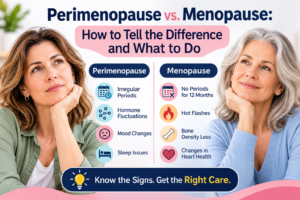
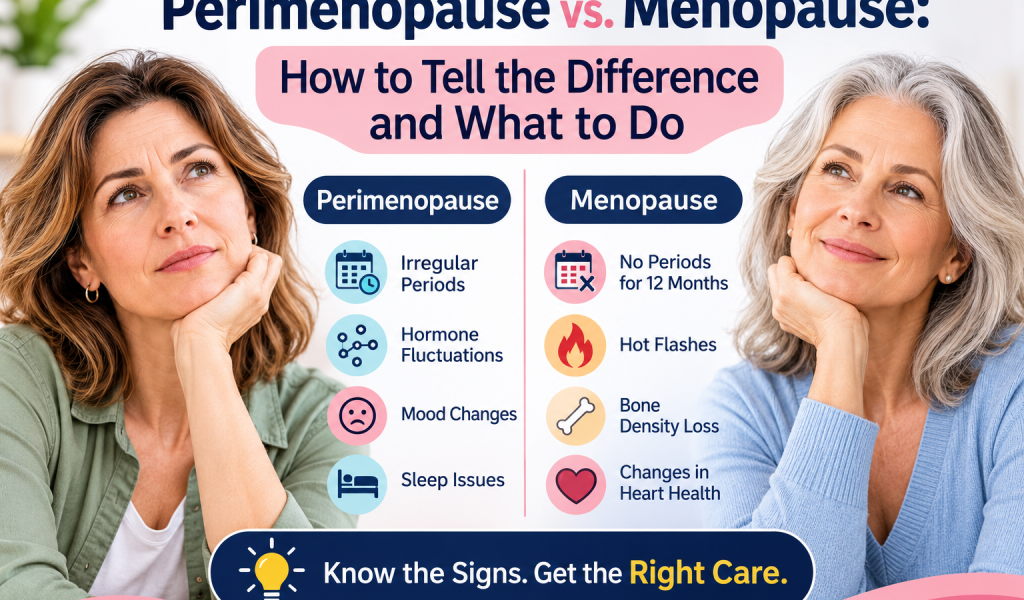
In 2012, Dr. Siobán Harlow established the criteria for perimenopause as the transition phase with irregular cycles and dramatic fluctuations in estrogen levels. Progesterone levels are the first to decline. Menopause is confirmed after 12 months without a period. Perimenopausal and menopausal symptoms overlap, but menstrual cycle irregularity with unpredictable swings usually point to the transition phase of peri-menopause. (1-2)
Two Stages, One Timeline
| Perimenopause | Menopause | |
| Typical timing | Often begins in the mid-forties | Average age is about 51 in the U.S. (3-4) |
| Periods | Irregular, skipped, lighter or heavier | Absent for 12 months |
| Hormones | Estrogen and progesterone fluctuate | Estrogen stays low |
| Duration | From 6 months to a few years, until the start of menopause. | From the start of menopause onward, indefinitely. |
Once the perimenopausal transition phase is completed, postmenopause follows. At this stage, menopausal symptoms such as hot flashes, night sweats, insomnia, fatigue, vaginal dryness and brain fog may become more severe and persistent, motivating the patient to seek relief with estrogen hormone replacement. (1) Women in our area can learn more about estrogen replacement therapy in South Florida.
Early Versus Late Perimenopause
In 2012, Dr. Siobán Harlow described early perimenopause as characterized by variable length of menstrual cycles. This is caused by intermittent anovulation. Late perimenopause brings more skipped periods and longer gaps of two months or longer, as anovulation occurs more often. When perimenopause is compared to menopause, symptoms are quite different at the start of the transition compared to the end of the transition. Hot flashes tend to appear and intensify as menstrual periods eventually stop and estrogen levels decline. (1–2)
Symptoms You Can Identify in Both
Hot flashes, night sweats, poor sleep, brain fog, and low mood can appear in both the transition stage and completed menopause. Symptom overlap can make diagnosis difficult.
Sleep deserves special mention. For many women, insomnia is the first symptom indicating the start of perimenopause. For more on this topic, see: why perimenopause causes insomnia which explains how hormonal imbalance causes insomnia.
See also my article Natural Progesterone for the Perimenopausal Transition, which details how oral micronized progesterone addresses sleep disturbance and night sweats when ovulation fails first.
Clues That Point to Perimenopause
- Menstrual Cycles become shorter, longer, or unpredictable
- Heavier bleeding, or bleeding between periods
- Breast tenderness and worsening premenstrual symptoms (PMS)
- Anxiety or irritability that arrives in waves
In 2011, Dr. Jerilynn C. Prior established that perimenopause is characterized by intermittent anovulation and loss of regular ovulation. Since progesterone production depends on ovulation, progesterone tends to decline first, while estrogen swings dramatically up and down. That uneven hormonal pattern makes perimenopause feel more chaotic than completed menopause. This may cause mood disturbance and anxiety as explained in the article: hormone imbalances and anxiety.
The conventional teaching that perimenopause is simply estrogen deficiency is wrong; it is often a state of estrogen excess relative to missing progesterone. (9–11)
Symptoms That Linger After Menopause
Once completed menopause is confirmed, estrogen remains low, and some symptoms continue to strengthen and become more severe. Without treatment with estrogen therapy, vaginal dryness, urinary urgency, sleep problems, and bone loss can all progress. Risk for cardiovascular disease increases during the menopausal transition. This can be prevented with estrogen hormone replacement. (12-14)
For more on these topics see:
Health Benefits of Menopausal Hormone Replacement
Estrogen Prevents Heart Disease Part One.
Estrogen Prevents Heart Disease Part Two.
When is the Best Time to Start Hormone Therapy?
Menopause heralds the onset of estrogen deficiency and its associated degenerative diseases. This calls for ongoing care, not just symptom relief. When is the best time to start hormone replacement therapy after menopause? Women who start hormone replacement within the first 5 years of menopausal transition have the best outcome, as explained in the article: best time to start hormone replacement therapy after menopause. Bioidentical estradiol (preferably transdermal) plus natural micronized progesterone is the preferred treatment approach; synthetic progestins should be avoided. (15–17)
Why a Single Hormone Test is Not Enough
In 2004, Dr. Nanette Santoro documented that hormone levels in perimenopause bounce from day to day with dramatic fluctuations in estrogen levels and in FSH levels. A single serum FSH or estradiol test result can be normal one week and menopausal the next. Diagnosis rests mostly on age, symptoms, and menstrual cycle history. (1) (5)
Could It Be Your Thyroid?
Our routine laboratory panel includes extensive thyroid testing. Various thyroid disorders and hypothyroidism cause fatigue, mood changes, and menstrual cycle disruption which can mimic perimenopausal transition. It is best not to miss the diagnosis. See our guide on how often thyroid levels are checked for more information on this topic.
Tracking Your Symptoms at Home
You are advised to keep a menstrual diary, a simple written log or calender, since memory is not always accurate. Record the first day of each period, flow heaviness, hot flashes, sleep quality, and mood. Add any triggers, such as alcohol or stress, that seem to matter.
After two or three months, patterns show up. Bring the log to your visit, because cycle timing is one of the strongest clues to your stage in the perimenopausal transition.
Pregnancy and Contraception During Transition
Perimenopause does not end fertility. Ovulation becomes unpredictable, so pregnancy remains possible until after completed menopause is confirmed. Women who want to avoid pregnancy usually continue contraception until 12 months have passed without a period, or longer if a clinician advises it. Many use barrier methods rather than birth control pills which can have adverse side effects. For more on this topic see: Adverse Effects of Birth Control Pills. (1)
Early Menopause: When Symptoms Start Early
Menopause before age 40 is called premature ovarian insufficiency, and menopause between 40 and 45 is considered early. Both deserve a proper evaluation, because long periods of estrogen deficiency greatly increase the risk of bone loss and cardiovascular disease, and increased mortality. If your menstrual cycles change dramatically in your thirties or early forties, do not assume it is normal. (6-7)
In 2020, Dr. Izaäk Schipper states menopausal hormone replacement eliminates the increased cardiovascular mortality associated with menopause, and advises starting HRT as soon as possible after the menopause transition, writing:
It has been substantiated that hormone replacement therapy (HRT) decreases the risk for ischemic heart disease and eliminates the increased cardiovascular disease mortality. It is therefore crucial to start HRT as soon as possible, particularly in women with premature ovarian insufficiency. (8)
Treatment Options at a Glance
- Diet and Lifestyle modification such as regular exercise, limited alcohol, and consistent sleep routines.
- Hormone therapy, which tends to work best when started before age 60 or within ten years of menopause.
- Local vaginal treatment for dryness and urinary symptoms.
Matching treatments to the stage of menopause is what we do. No need to memorize perimenopause vs menopause symptoms and try to do it on your own. In perimenopause, oral micronized progesterone (often 100–300 mg at bedtime, cyclic or continuous as appropriate) frequently addresses the core progesterone deficiency before full estrogen replacement is needed. Once menopause is established, bioidentical estradiol (transdermal preferred for lower clotting risk) plus progesterone provides symptom relief and long-term protection against bone loss, cardiovascular disease, and other degenerative changes associated with estrogen deficiency. (9-11)
What to Do Next
- Keep a menstrual cycle diary and track your cycle and symptoms for two to three months.
- Ask for a thyroid lab panel check and other basic labs to rule out other causes.
- Report heavy bleeding, bleeding after sex, or bleeding after 12 months without a period (post-menopausal bleeding).
- Discuss treatment options once the pattern is clarified.
See your OB/GYN clinician promptly for heavy menstrual bleeding that soaks a pad every hour, periods closer than 21 days apart, or any bleeding after menopause (post-menopausal bleeding).
We Can Help
If you are experiencing perimenopausal or menopausal symptoms, we can help. The TruemedMD clinic and our medical director, Jeffrey Dach, MD, will evaluate your symptom pattern, medical history, physical examination and complete laboratory panel. We will have a full discussion of treatment options including the different estrogen formulas and types of estrogens used, so you understand what you are actually taking. We then devise a treatment program tailored to you with careful follow up to monitor response to treatment, so you are never left on your own.
Review our services page, then use the contact page to schedule a consultation.
Frequently Asked Questions
At what age does perimenopause start?
It often starts in the mid-forties, but it can begin earlier or later.
How long does perimenopause last?
Usually a year or two, though some women experience it for longer.
Can I get pregnant during perimenopause?
Yes. Ovulation becomes irregular but does not stop, so contraception is still needed if pregnancy is not wanted.
Do I need a blood test to confirm menopause?
Usually not. After 12 months without a period at the typical age, menopause is diagnosed clinically.
Are hot flashes worse in perimenopause or menopause?
They can occur in both. Many women have the most intense symptoms around the late transition and early postmenopause.
Articles with Related Interest:
Health Benefits of Menopausal Hormone Replacement
Natural Progesterone for the Perimenopausal Transition,
Estrogen Prevents Heart Disease Part One.
Estrogen Prevents Heart Disease Part Two.
Adverse Effects of Birth Control Pills.
References:
1. Harlow, Siobán D., et al. “Executive Summary of the Stages of Reproductive Aging Workshop +10: Addressing the Unfinished Agenda of Staging Reproductive Aging.” Menopause, vol. 19, no. 4, 2012, pp. 387–95.
2. Harlow, Siobán D., et al. “Executive Summary of the Stages of Reproductive Aging Workshop +10: Addressing the Unfinished Agenda of Staging Reproductive Aging.” Climacteric, vol. 15, no. 2, 2012, pp. 105–14.
3. Appiah, Duke, et al. “Trends in Age at Natural Menopause and Reproductive Life Span Among US Women, 1959-2018.” *JAMA*, vol. 325, no. 13, 2021, pp. 1328–30.
4. Schulz, Rebecca N., et al. “Age at Natural and Surgical Menopause and Related Factors: NHANES 2013-2023.” *Menopause*, 2026.
5. Santoro, Nanette, et al. “Body Size and Ethnicity Are Associated with Menstrual Cycle Alterations in Women in the Early Menopausal Transition: The Study of Women’s Health Across the Nation (SWAN) Daily Hormone Study.” Journal of Clinical Endocrinology & Metabolism, vol. 89, no. 6, 2004, pp. 2622–31. https://doi.org/10.1210/jc.2003-031578
6. Panay, Nick, et al. “Evidence-Based Guideline: Premature Ovarian Insufficiency.” Human Reproduction Open, vol. 2024, no. 4, 2024, hoae065.
7. European Society of Human Reproduction and Embryology (ESHRE), American Society for Reproductive Medicine, International Menopause Society, et al. “Evidence-Based Guideline: Premature Ovarian Insufficiency.” 2024.
8. Schipper, I., and Y. V. Louwers. “Premature and Early Menopause in Relation to Cardiovascular Disease.” Seminars in Reproductive Medicine. Vol. 38. No. 4-05. 2020.
9. Prior, Jerilynn C. “Progesterone for Symptomatic Perimenopause Treatment – Progesterone Politics, Physiology and Potential for Perimenopause.” Facts, Views & Vision in ObGyn, vol. 3, no. 2, 2011, pp. 109–20.
10. Prior, Jerilynn C., et al. “Oral Micronized Progesterone for Perimenopausal Night Sweats and Hot Flushes: A Phase III Canada-Wide Randomized Placebo-Controlled 4 Month Trial.” Scientific Reports, vol. 13, 2023, article 9082.
11. Hitchcock, Christine L., and Jerilynn C. Prior. “Oral Micronized Progesterone for Vasomotor Symptoms—A Placebo-Controlled Randomized Trial in Healthy Postmenopausal Women.” Menopause, vol. 19, no. 8, 2012, pp. 886–93.
12. Schierbeck, Louise L., et al. “Effect of Hormone Replacement Therapy on Cardiovascular Events in Recently Postmenopausal Women: Randomised Trial.” BMJ, vol. 345, 2012, e6409.
13. Hodis, Howard N., and Wendy J. Mack. “Menopausal Hormone Replacement Therapy and Reduction of All-Cause Mortality and Cardiovascular Disease: It Is About Time and Timing.” Cancer Journal, vol. 28, no. 3, 2022, pp. 208–23.
14. Salpeter, Shelley R., et al. “Bayesian Meta-analysis of Hormone Therapy and Mortality in Younger Postmenopausal Women.” Journal of General Internal Medicine, vol. 21, no. 7, 2006, pp. 727–34.
15. Canonico, Marianne, et al. “Hormone Therapy and Venous Thromboembolism among Postmenopausal Women: Impact of the Route of Estrogen Administration and Progestogens: The ESTHER Study.” Circulation, vol. 115, no. 7, 2007, pp. 840–45.
16. Scarabin, Pierre-Yves. “Progestogens and Venous Thromboembolism in Menopausal Women: An Updated Oral Versus Transdermal Estrogen Meta-analysis.” Climacteric, vol. 21, no. 4, 2018, pp. 341–45.
17. Vinogradova, Yana, et al. “Use of Hormone Replacement Therapy and Risk of Venous Thromboembolism: Nested Case-Control Studies Using the QResearch and CPRD Databases.” *BMJ*, vol. 364, 2019, k4810.