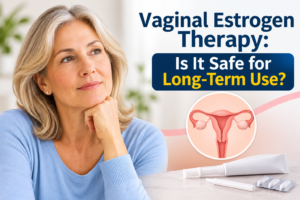

Short answer: for most women, low-dose vaginal estrogen is considered safe to use for years. Vaginal estrogen is safer than estrogen skin patches or pills because very little estrogen reaches the bloodstream. Women with active cancer, unexplained bleeding, or active blood clots need an individual review first. As I have written in Menopausal Hormone Replacement Health Benefits and Hormone Replacement for Breast Cancer Survivors Part Two, local vaginal estrogen is one of the most effective and underused tools we have for restoring tissue that has thinned from estrogen deficiency.
What is Vaginal Atrophy?
One of the more disturbing symptoms of menopausal estrogen deficiency is vaginal dryness related to vaginal atrophy. Why does this happen? This is directly caused by menopausal estrogen deficiency. Good estrogen levels are required to maintain the integrity of the vaginal mucosa. Menopause specialist Dr. Louise Newson, based in the U.K., argues that local vaginal estrogen is not an optional cosmetic fix. Rather, low-dose vaginal estrogen is a highly efficacious treatment to restore and maintain urogenital tissue. Dr. Newson describes the range of genitourinary symptoms from estrogen deficiency: burning, pain with sex, urgency, dysuria, and repeated urinary infections. Most OB/GYN doctors suggest first trying moisturizers and lubricants. However, these do not restore estrogen-dependent tissues. In my practice I see the same pattern—women treated for years with antibiotics or moisturizers for problems that respond to restoration of local estrogen. (1)
A Primary-Care Blind Spot
In 2016, Dr. Louise Newson argued that under-prescribing vaginal estrogen remains a significant primary-care blind spot. In an editorial, she noted that a full year’s supply of local therapy delivers a cumulative systemic dose equivalent to just one standard oral estrogen hormone tablet. Sadly, recurrent urinary infections with negative cultures are often treated by the primary care with repeated antibiotics instead of local estrogen hormone restoration with vaginal estrogen. Broad pharmacological data confirm that vaginal estrogen products yield minimal systemic exposure to estrogen. In 2006, Dr. John Suckling’s review of 19 trials found that vaginal creams, tablets, pessaries, and rings relieve atrophy better than placebo, with a strong preference for the estradiol ring. In 2011, Dr. David Sturdee and Dr. Amos Pines outlined treatment of vaginal atrophy with estrogen. Dr. Newson’s 2023 podcast adds that local hormones do not meaningfully raise blood estrogen levels. (1-4)
Why It Behaves Differently From Pills and Patches
Vaginal estrogen comes as a capsule, cream, tablet, or suppository. It works mainly on vaginal and urinary tissue, which thins and dries when estrogen levels decline after menopause. The result can be burning, dryness, painful sex, urinary urgency, and recurrent urinary infections. Standard low doses raise blood estrogen only slightly, if at all. That is why professional societies treat vaginal products as a separate category from systemic hormone therapy. In my article, FDA Removes Black Box Warning Label from Estrogen, I noted that the medical literature does not support the same warnings for vaginal estrogen that were applied to systemic estrogen products. (5)
Which Product Form Fits Best
Creams allow flexible dosing but can be messy. Capsules, tablets and suppositories use an applicator and tend to be tidier. An estradiol ring releases estradiol steadily and is replaced about every three months. In the United States the two rings that fit this description are Estring (estradiol, releasing about 7.5 mcg per day) and Femring (estradiol acetate, available in 0.05 mg/day and 0.10 mg/day strengths). The best form is the one a woman will actually use consistently. Comfort, hand dexterity, and personal preference all matter because missed doses reduce the benefit. In my office we frequently use compounded vaginal capsules containing estriol with or without testosterone for milder cases, and bi-est (estriol/estradiol) with progesterone for more severe symptoms, as described in Hormone Replacement for Breast Cancer Survivors Part Two. (6)
What to Expect From Treatment
Many women notice relief within a few weeks, though full tissue recovery takes longer. Moisturizers and lubricants can ease discomfort, but they do not treat vaginal atrophy, and do not rebuild thinned vaginal wall tissue. Estrogen is the best and most effective treatment for vaginal atrophy. Symptoms usually return once treatment stops because the tissues thin again without estrogen. That is why many women stay on vaginal estrogen for the long term for many years. This raises the question about safety over the long-term. (7)
Dosing Schedules Over Time
Many regimens begin with daily or near-daily use for the first few weeks, then drop to a maintenance schedule a couple of times a week. The exact plan depends on the type of product and your response. The frequency of use and dosage should be adjusted by your prescribing physician. Symptoms return when stopping the vaginal estrogen, a reminder to restart the treatment. Women who also need systemic relief can explore estrogen therapy in South Florida.
What the Research Says About Long-Term Use
Most clinical trials run a year or less, so solid long-term data remain limited. Large observational studies have generally not shown severe adverse effects such as increases in blood clots, stroke, or breast cancer with low-dose vaginal products. The uterine lining is the other concern. At low doses, added progesterone is generally not needed, but any vaginal bleeding after menopause should be reported promptly. Post-menopausal bleeding deserves a pelvic exam, and pelvic sonogram. A wait-and-see approach is not recommended. In Hormone Replacement for Breast Cancer Survivors Part Two, I reviewed data showing vaginal estradiol alone was associated with lower recurrence risk in one series of breast cancer survivors reported by Dr. Eva Durna in 2002. (8-10)
What Vaginal Estrogen Safety Looks Like Over the Years
Safety is a plan, not a label. A sensible long-term plan includes:
- The lowest dose that controls symptoms
- A yearly review of symptoms, bleeding, and medical history
- Updates whenever your health changes, such as a new diagnosis or medication
Products also use different estrogens. Estradiol is the most studied. Estriol is a weaker estrogen with a smaller evidence base. The difference between estradiol (E2) and estriol (E3) is explained in this article on Estradiol vs. Estriol.
Common Concerns, Answered Plainly
Straight talk about vaginal estrogen safety includes the questions people hesitate to ask.
- Can a partner be exposed? Small amounts can transfer, which is why many women apply it at bedtime and avoid intercourse right afterward.
- Does it help prevent urinary infections? In postmenopausal women with recurrent infections, vaginal estrogen is the best treatment which prevents recurrent urinary tract infections.
- Will it relieve hot flashes? Usually not. Standard low dose vaginal estrogen only targets local tissue, and does not resolve systemic menopausal symptoms. (11-13)
Who Should Pause and Ask Questions First
- A history of breast or uterine cancer
- Vaginal bleeding with no known cause
- Current or past blood clots or stroke
- Use of an aromatase inhibitor, where even small estradiol rises matter
Breast cancer survivors need a separate conversation with their oncologist. Our article on vaginal estrogen for cancer survivors covers that situation in depth. See Hormone Replacement for Breast Cancer Survivors Part Two for additional discussion of the data in this population. (14)
Signs It Is Time for a Check-In
Call your clinician sooner than your yearly review if you notice:
- Any new vaginal bleeding or spotting
- A new breast lump or nipple change
- Pelvic pain, or symptoms that persist despite steady use
- A new medication or diagnosis that could change the picture
Myths That Keep Women From Treatment
- “It carries the same risks as hormone pills.” No, this is false. Absorption is far lower, so the risk profile is different.
- “Dryness is just aging, so I should put up with it.” No, this is not a good idea. Tissue changes are treatable, and relief is possible.
- “It is only for women who are sexually active.” No, this is false. Vaginal estrogen relieves the daily irritation, urinary urgency, and recurrent infections, whether sexually active or not.
Questions to Bring to Your Appointment
- Which dose and form fit my symptoms and history?
- How often should we review this treatment?
- Which warning signs mean I should call right away?
We are here to help. At our TruemedMD clinic in Davie, Florida, our team can walk you through available treatment options. Browse through our services page or reach out through our contact page when you are ready to take the next step.
Frequently Asked Questions
Does vaginal estrogen enter the bloodstream?
A small amount can, but standard low doses raise blood estrogen only slightly compared with pills.
Can I use vaginal estrogen for years?
Many women do. Long-term use should include regular review of symptoms, bleeding, and medical history.
Does vaginal estrogen cause breast cancer?
Large observational studies have not shown a clear increase with low-dose products, but women with a cancer history need individual advice.
Do I need progesterone with vaginal estrogen?
At low doses, added progesterone is generally not needed. Report any postmenopausal bleeding promptly.
Is vaginal estrogen the same as hormone replacement therapy?
No. It mainly treats local symptoms, while systemic therapy delivers estrogen throughout the body.
Articles with Related Interest
Vaginal Estrogen for Breast Cancer Survivors: is it Safe?
Menopausal Hormone Replacement Health Benefits
Hormone Replacement for Breast Cancer Survivors Part Two
FDA Removes Black Box Warning Label from Estrogen
References
1. Newson, Louise R. “Best Practice for HRT: Unpicking the Evidence.” British Journal of General Practice, vol. 66, no. 653, 2016, pp. 597–98.
2. Suckling, John, et al. “Local Oestrogen for Vaginal Atrophy in Postmenopausal Women.” Cochrane Database of Systematic Reviews, no. 4, 2006, CD001500.
3. Sturdee, David W., and Amos Pines. “Updated IMS Recommendations on Postmenopausal Hormone Therapy and Preventive Strategies for Midlife Health.” *Climacteric*, vol. 14, no. 3, 2011, pp. 302–20.
4. Newson, Louise. “How Vaginal Hormones Can Transform Lives.” *The Dr Louise Newson Podcast*, 1 Aug. 2023.
5. Dach, Jeffrey. “FDA Removes Black Box Warning Label from Estrogen.” Jeffrey Dach MD, 8 Dec. 2025.
6. Dach, Jeffrey. “Hormone Replacement for Breast Cancer Survivors Part Two.” Jeffrey Dach MD, 17 Nov. 2024.
7. Simon, James, et al. “Effective Treatment of Vaginal Atrophy with an Ultra–Low-Dose Estradiol Vaginal Tablet.” Obstetrics & Gynecology, vol. 112, no. 5, 2008, pp. 1053–60.
8. Crandall, Carolyn J., et al. “Breast Cancer, Endometrial Cancer, and Cardiovascular Events in Participants Who Used Vaginal Estrogen in the Women’s Health Initiative Observational Study.” Menopause, vol. 25, no. 1, 2018, pp. 11–20.
9. Durna, Eva M., et al. “Breast Cancer in Postmenopausal Women: The Impact of Menopausal Hormone Replacement Therapy.” Medical Journal of Australia, 2002.
10. Rahn, David D., et al. “Vaginal Estrogen for Genitourinary Syndrome of Menopause: A Systematic Review.” *Obstetrics & Gynecology*, vol. 124, no. 6, 2014, pp. 1147–56.
11. Ferrante, Kimberly L., et al. “Vaginal Estrogen for the Prevention of Recurrent Urinary Tract Infection in Postmenopausal Women: A Randomized Clinical Trial.” *Female Pelvic Medicine & Reconstructive Surgery*, vol. 27, no. 2, 2021, pp. 112–17.
12. Raz, Raul, and Walter E. Stamm. “A Controlled Trial of Intravaginal Estriol in Postmenopausal Women with Recurrent Urinary Tract Infections.” New England Journal of Medicine, vol. 329, no. 11, 1993, pp. 753–56.
13. Lethaby, Anne, et al. “Local Oestrogen for Vaginal Atrophy in Postmenopausal Women.” *Cochrane Database of Systematic Reviews*, 2016.
14. Agrawal, Priyanka, et al. “Safety of Vaginal Estrogen Therapy for Genitourinary Syndrome of Menopause in Women with a History of Breast Cancer.” *Obstetrics & Gynecology*, vol. 142, no. 3, 2023, pp. 660–68.