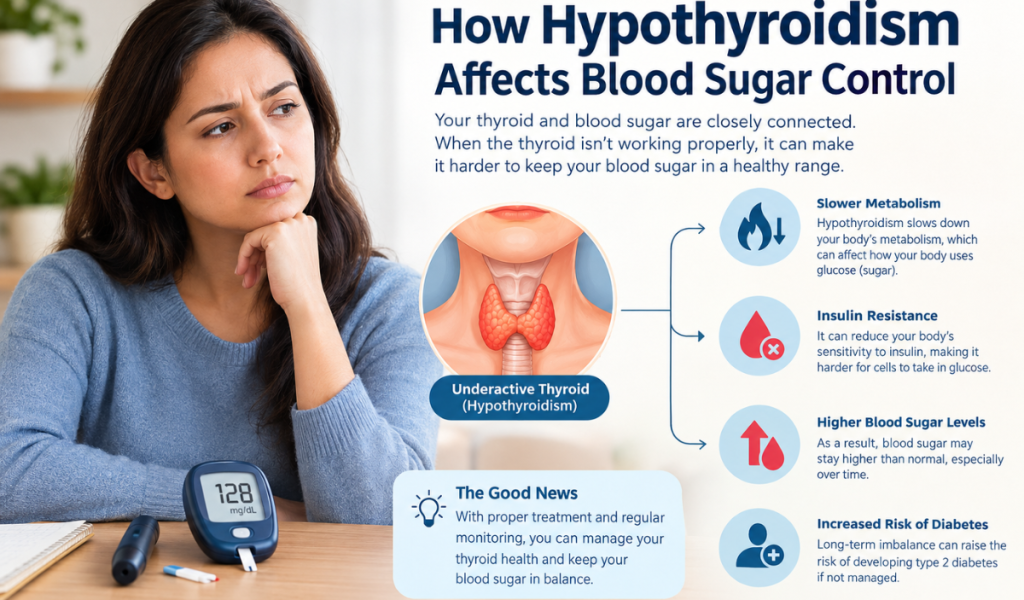
Patients with hypothyroidism may have a blood sugar problem. This includes people with thyroid disease who also have prediabetes, or diabetes. An underactive thyroid affects how the body uses energy, responds to insulin, and processes blood sugar (glucose). Hypothyroidism slows down your overall metabolism, making diabetes more difficult to manage.
If you are diabetic, you may be told to modify your diet, watch your carbohydrates, lose weight, or exercise more, but what if your thyroid is also affecting the way your body handles glucose?
Your doctor should look beyond blood sugar and consider thyroid function as another factor affecting overall metabolic health.
What Is the Connection Between Hypothyroidism and Blood Sugar?
Hypothyroidism can affect glucose metabolism and complicate blood sugar management. Low thyroid hormone levels affect insulin sensitivity, glucose production, and how the body uses energy.
As you know, the thyroid gland produces thyroid hormone which regulates our metabolism. When the thyroid is underactive, metabolism slows down. Not everyone with hypothyroidism will develop diabetes. However, thyroid dysfunction can be relevant to the diabetic, making elevated fasting blood sugar more difficult to manage.
How Thyroid Hormones Affect Metabolism
Thyroid hormones, thyroxine (T4) and triiodothyronine (T3), help regulate metabolism, whether our calories are converted to energy or stored up as body fat. Thyroid hormone also improves glucose uptake by the liver, muscles, and other tissues involved in glucose metabolism.
In hypothyroidism, thyroid hormone levels are low, thus reducing insulin sensitivity, glucose utilization, and blood sugar regulation. The relationship is complex and varies from person to person.
Broda Barnes and Hypothyroidism
In 1976, Dr. Broda O. Barnes wrote a classic book entitled, Hypothyroidism: The Unsuspected Illness which argues that the low thyroid condition is far more common than doctors recognize, frequently missed, and an underlying driver of many chronic complaints. Dr. Barnes presented hypothyroidism as a metabolic problem in which insufficient thyroid hormone slows cellular energy use, producing a wide range of physical and mental symptoms that patients and physicians often attributed to other causes. Dr. Barnes made a number of clinical observations concerning the benefit of thyroid treatment for the diabetic patient. (7)
- Many diabetic or prediabetic patients have low basal body temperature and other signs of hypothyroidism.
- Both diabetic and hypothyroid patients can have abnormal glucose-tolerance tests, and additional testing is required to distinguish diabetes from hypothyroidism.
- Dr. Barnes claimed a very high co-occurrence of hypothyroidism in his diabetic patients.
- In his clinical practice with adequate thyroid treatment, Dr. Barnes saw almost no classic diabetic complications, such as diabetic kidney disease, accelerated atherosclerosis, premature heart attacks, or retinal changes, etc. Dr. Barnes argued that adequate thyroid replacement in hypothyroid diabetics prevented the atherosclerosis that drives most long-term complications, even with imperfect blood-sugar control.
- Hypoglycemia (low blood sugar) is often due to a sluggish liver which fails to convert glycogen to glucose on demand. Dr. Barnes reported hypoglycemic episodes became less frequent after thyroid treatment as liver glycogen conversion to glucose normalized on thyroid therapy.
Can Hypothyroidism Cause Insulin Resistance?
Hypothyroidism may be associated with insulin resistance, a condition in which the body’s cells respond less effectively to insulin. This can make it more difficult for glucose to be cleared from the bloodstream, thus leading to elevated blood sugar levels.
Insulin resistance is a feature of type 2 diabetes. In patients with hypothyroidism and elevated blood sugar, the physician should keep in mind both conditions, and evaluate and treat both when present. Factors that influence insulin resistance include: body composition, physical activity, genetics, sleep, and other hormonal conditions.
Does Hypothyroidism Raise Blood Sugar?
Hypothyroidism can influence blood sugar, but the effect is variable and not always straightforward. Some patients may have abnormal blood sugar, while others may have normal blood sugar levels.
Hypothyroidism and Hemoglobin A1C Results
What is the hemoglobin A1C? The hemoglobin A1C test shows the amount of sugar that has been attached to the hemoglobin in red blood cells. This is an estimate for average blood glucose over three months. As such, HbgA1c can be regarded as a long term marker for dietary sugar consumption, and the fasting blood sugar level.
In 2015, a study by Dr. Anantarapu found that in hypothyroid patients, hemoglobin A1c may be falsely elevated, and thyroid hormone treatment will lower the hemoglobin A1C (HbA1c). However, fasting glucose and glucose tolerance will not change. Thus, hypothyroidism may increase the HbA1c independent of the fasting blood sugar level.
What is the mechanism? The mechanism is well documented: hypothyroidism slows red-cell production; treatment with thyroid hormone speeds it up with higher reticulocyte count and higher mean corpuscular hemoglobin. Note: reticulocytes are immature red blood cells made by the bone marrow.
Because HbA1c reflects the percentage of glycated hemoglobin over the life of the red cell, longer-lived red blood cells accumulate more glycation even if average glucose is unchanged. Fasting glucose remains stable in these key studies, and does not change. (4-6)
What Symptoms May Suggest a Thyroid and Blood Sugar Problem?
Symptoms of hypothyroidism and abnormal blood sugar can overlap, making it difficult to identify the underlying cause without testing.
Possible hypothyroidism symptoms include:
- Fatigue and low energy
- Weight gain or difficulty managing weight
- Feeling cold
- Constipation
- Dry skin
- Difficulty concentrating
High blood sugar may also cause increased thirst, frequent urination, blurred vision, or fatigue. However, many people with prediabetes have no noticeable symptoms.
Which Tests Help Evaluate Thyroid and Blood Sugar?
A combination of thyroid and metabolic testing can help clarify whether hypothyroidism may be affecting blood sugar management.
Thyroid Function Tests
Common tests include:
- TSH, which is usually the initial test for evaluating thyroid function.
- Free T4, which measures the available thyroid hormone in the blood.
- Free T3, which measures the biologically active thyroid hormone.
- Reverse T3, which Japanese thyroid specialists consider the most accurate marker for thyroid function.
- Thyroid antibodies, when autoimmune thyroid disease such as Hashimoto’s thyroiditis is suspected. We include this test routinely for all new patients.
- The chem panel done in a fasting state includes blood glucose.
- The hemoglobin A1C test is a long term marker for sugar consumption.
Although the American Thyroid Association considers the TSH and free T4 tests adequate for evaluating hypothyroidism, and consider reverse T3 and T3 testing unnecessary, I would disagree with this. Instead, we use the expanded panel as listed above which provides much more information.
Blood Sugar Tests
Depending on the patient’s situation, a clinician may consider:
- Fasting blood glucose
- Hemoglobin A1C
- Serum insulin
- Oral glucose tolerance testing, when appropriate
- Additional metabolic testing based on symptoms and medical history
We review all laboratory results together with you, and provide you with a copy of your test results. This gives us the information to distinguish the effect of thyroid dysfunction on the Hemoglobin A1C.
How Can Patients Support Better Blood Sugar Control?
Managing blood sugar with hypothyroidism requires a combination of thyroid hormone treatment and attention to broader metabolic health with diet and lifestyle modification. Namely, the low glycemic diet and exercise program.
Follow the Prescribed Thyroid Treatment
Take your thyroid medication as directed and attend recommended follow-up testing. The American Thyroid Association advises checking thyroid blood tests after starting or changing thyroid hormone treatment so the dose can be adjusted when needed. We typically monitor thyroid labs at 6 weeks intervals when starting or changing dosage.
Support Metabolic Health
Helpful habits may include:
- For prediabetics and diabetics, a low glycemic diet and adequate exercise.
- Eating balanced meals with good protein and fiber.
- Staying physically active as tolerated by health status.
- Getting good quality sleep.
- Monitoring blood sugar with a home glucometer.
- Discussing change in weight, fatigue and other symptoms, and any adverse effects of medication with your doctor.
When Should You Discuss Hypothyroidism and Blood Sugar With a Doctor?
Speak with a healthcare professional if you have hypothyroidism and unexplained changes in hemoglobin A1C, fasting glucose, or blood sugar readings. The combination of hypothyroidism with elevated fasting blood sugar can cause long term serious complications.
Reviewing thyroid function, medications, symptoms, and metabolic testing may help determine whether low thyroid is a contributing factor. Patients with diabetes should continue their prescribed glucose management plan while thyroid concerns are evaluated.
How TruemedMD and Jeffrey Dach, MD Can Help
At the TruemedMD Clinic, our medical director Jeffrey Dach, MD provides integrative and preventive medicine focused on thyroid health, metabolism, and hormone care. To learn more about the TruemedMD clinic and Dr. Jeffrey Dach MD’s approach to thyroid and metabolic health, contact the officeto make an appointment.
Frequently Asked Questions
Can hypothyroidism cause diabetes?
Hypothyroidism does not directly cause diabetes in every patient. However, thyroid dysfunction and type 2 diabetes can occur together, and low thyroid function may be associated with changes in insulin sensitivity and glucose metabolism.
Can hypothyroidism affect A1C levels?
Yes, hypothyroidism may affect hemoglobin A1C interpretation in some patients. Research summarized by the American Thyroid Association found that thyroid hormone treatment lowered A1C in certain patients without a corresponding significant change in fasting glucose or glucose tolerance. (4-6)
Should people with diabetes get their thyroid checked?
Thyroid testing may be appropriate for people with diabetes when symptoms or clinical findings suggest thyroid dysfunction. Your doctor can determine which tests are suitable based on medical history and current blood sugar management.
What Type of Thyroid Hormone is Best?
Mainstream endocrinology tends to use T4-only medication such as Levothyroxine to treat low thyroid hormone levels. At the TruemedMD office, we prefer to use a combination T3 and T4 therapy in the form of natural desiccated thyroid (NDT). Combination T3 and T4 therapy is superior to T4-only therapy as shown by a June 2025 study by Dr. Antonio Bianco’s group showing combination therapy provides protection from dementia and reduced mortality when compared to T4-only medication. (8)
Conclusion:
Hypothyroidism is linked to insulin resistance in muscle and fat and altered hepatic glucose metabolism. Untreated hypothyroidism in a diabetic can worsen insulin resistance making elevated fasting blood sugar harder to control, and increase cardiovascular risk. Some studies link subclinical hypothyroidism to higher rates of diabetic complications such as renal disease, retinopathy, neuropathy, and peripheral arterial disease. Treating overt hypothyroidism in diabetics generally improves insulin sensitivity and reduces risk of diabetic complications. (1-3)
Articles with Related Interest:
Combination T3 and T4 Reduces Mortality and Dementia
Which Thyroid is Best, Natural Synthetic or Combination?
Reverse T3, Useful or a Waste of Time?
Errors in Modern Endocrine Thyroidology
References:
1. Biondi, Bernadette, et al. “Thyroid Dysfunction and Diabetes Mellitus: Two Closely Associated Disorders.” Endocrine Reviews, vol. 40, no. 3, 2019, pp. 789–824.
2. Han, Cheng, et al. “Subclinical Hypothyroidism and Type 2 Diabetes: A Systematic Review and Meta-Analysis.” PLoS ONE, vol. 10, no. 8, 2015, e0135233.
3. Chaker, Layal, et al. “Thyroid Function and Risk of Type 2 Diabetes: A Population-Based Prospective Cohort Study.” BMC Medicine, vol. 14, 2016, article 150.
4. Anantarapu, Sailaja, et al. “Effects of Thyroid Hormone Replacement on Glycated Hemoglobin Levels in Non Diabetic Subjects with Overt Hypothyroidism.” Archives of Endocrinology and Metabolism, vol. 59, no. 6, 2015, pp. 495–500.
5. American Thyroid Association. “Hypothyroidism Is Associated with a Faulty Increase in Hemoglobin A1C Levels.” Clinical Thyroidology for Patients, vol. 9, no. 2, Feb. 2016, p. 6.
6. Kim, Mee Kyoung, et al. “Effects of Thyroid Hormone on A1C and Glycated Albumin Levels in Nondiabetic Subjects with Overt Hypothyroidism.” Diabetes Care, vol. 33, no. 12, 2010, pp. 2546–48.
7. Barnes, Broda O., and Lawrence Galton. Hypothyroidism: The Unsuspected Illness. Thomas Y. Crowell / Harper & Row, 1976.
8. Beltrão, Fabyan Esberard de Lima, et al. “Treatment of Hypothyroidism that Contains Liothyronine is Associated with Reduced Risk of Dementia and Mortality.” The Journal of Clinical Endocrinology & Metabolism (2025): dgaf367.