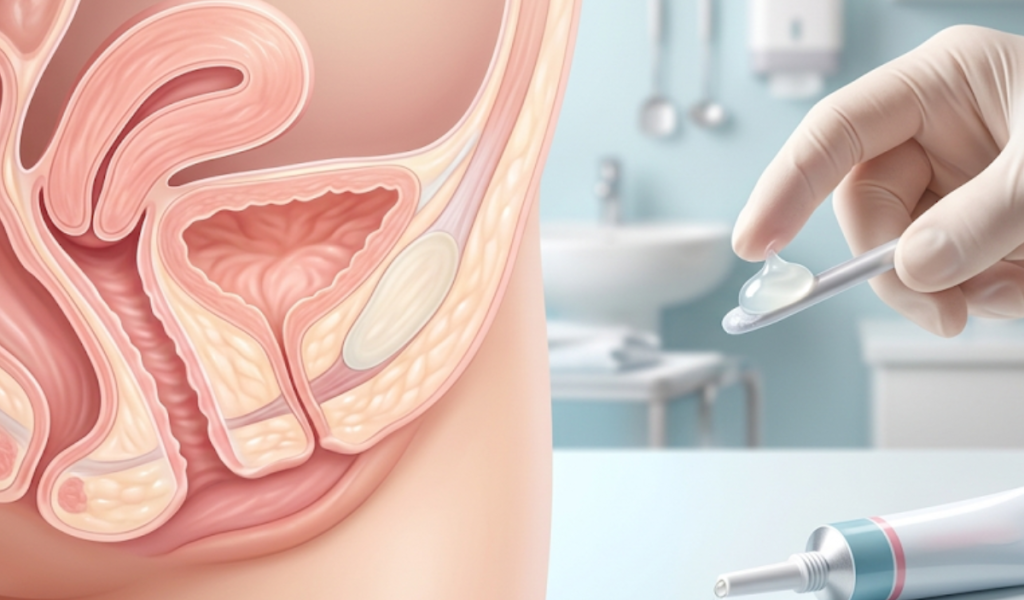
One of the more disturbing symptoms of menopausal estrogen deficiency is vaginal dryness related to vaginal atrophy. Why does this happen? This is directly caused by menopausal estrogen deficiency. Good estrogen levels are required to maintain the integrity of the vaginal mucosa. Menopause specialist Dr. Louise Newson, based in the U.K., argues that local vaginal estrogen is not an optional cosmetic fix. Rather, low-dose vaginal estrogen is a highly efficacious treatment to restore and maintain urogenital tissue. Dr. Newson describes the range of genitourinary symptoms from estrogen deficiency: burning, pain with sex, urgency, dysuria, and repeated urinary infections. Most OB/GYN doctors suggest first trying moisturizers and lubricants. However, these do not restore estrogen-dependent tissues. Creams, tablets, and rings are not interchangeable, and the dose matters, especially for women on aromatase inhibitors, as discussed below.
In 2016, Dr. Louise Newson argues that under-prescribing vaginal estrogen remains a significant primary-care blind spot. In an editorial, she noted that a full year’s supply of local therapy delivers a cumulative systemic dose equivalent to just one standard oral estrogen hormone tablet. Sadly, recurrent urinary infections with negative cultures are often treated by the primary care with repeated antibiotics instead of local estrogen hormone restoration with vaginal estrogen. Broad pharmacological data confirm that vaginal estrogen products yield minimal systemic exposure to estrogen. In 2006, Dr. John Suckling’s review of 19 trials found that vaginal creams, tablets, pessaries, and rings relieve atrophy better than placebo, with a strong preference for the estradiol ring. In 2011, Dr. David Sturdee and Dr. Amos Pines outlined symptom treatment and bone protection for women under 60. Her 2023 podcast adds that local hormones do not meaningfully raise blood estrogen levels. (1, 4)
In 2025, Dr. Sarah Glynne co-authored a consensus analysis of hormone therapy after breast cancer. Recommendations were developed by a 25-member multidisciplinary panel. The publication says vaginal estrogen is unlikely to increase recurrence because systemic absorption is exceptionally low. The panel’s statement does not apply for higher dosage vaginal estrogen which does have systemic effects. (5)
Here is Dr. Dach’s article on Dr. Avrum Bluming’s 25 studies showing no increased recurrence: Hormone Replacement for Breast Cancer Survivors Part Two
ACOG Says Low Dose Vaginal Estrogen May Be Used
In 2016, the American College of Obstetricians and Gynecologists said low-dose vaginal estrogen may be used after counseling if nonhormonal options fail. The same year, Dr. A. Kendall reported that vaginal estradiol tablets temporarily reversed aromatase suppression of estrogen in women taking aromatase inhibitors. The tablet studied was an older 25-microgram dose. Newer 10-microgram tablets and rings are lower-dose, but a woman on an aromatase inhibitor still needs consultation with her oncologist who should weigh in on the decision. Tamoxifen blocks the receptor rather than suppressing estrogen production, so the same caution does not apply automatically to tamoxifen. (5, 7)
The GSM Name
In 2026, Dr. Sara Perelmuter and colleagues said the name “genitourinary syndrome of menopause” (GSM) is too narrow. Postpartum women, breastfeeding mothers, and women on hormonal contraception can have the same thinning and dryness without being menopausal. They propose the name “genitourinary syndrome,” divided into estrogen deficiency types and androgen deficiency types, so in these patients, their worrisome vulvar, urinary, and sexual symptoms are not dismissed by the primary care doctor.
Low estrogen is a hormone state, not an age. In 2014, Dr. David Portman and Dr. Margery Gass named the syndrome. That year, Dr. Rossella Nappi and Dr. Santiago Palacios linked it to worse sexual health and quality of life. Vaginal prasterone, a DHEA product, is different from estradiol. Local tissue turns it into estrogen and androgen. Evidence after for vaginal DHEA in breast cancer is still limited. (8, 9)
Vaginal Estrogen Not Associated with Excess Breast Cancer Risk
In 2019, the Collaborative Group on Hormonal Factors in Breast Cancer (CGHFBC) published a meta-analysis of 24 prospective observational studies in 2019 and reported that “every MHT type, except vaginal estrogens, was associated with excess breast cancer risks which increased steadily with duration of use and were greater for estrogen-progestogen than estrogen only preparations.” Note: the term progestogen refers to synthetic progestins. These are chemically altered versions of progesterone, such as medroxyprogesterone and norethisterone and others. (11)
Four Questions Before Starting Vaginal Estrogen
Has my doctor reviewed the pathology report showing size of nodule, hormone-receptor status, KI-67, margins, axillary node status?
In 2025, Dr. Sarah Glynne and colleagues said vaginal estrogen is unlikely to increase risk of recurrence because absorption is low (5). In 2016, the American College of Obstetricians and Gynecologists likewise limited its opinion to women with a history of estrogen-dependent breast cancer and allowed low-dose vaginal estrogen after counseling if nonhormonal care had failed (7). (5, 7)
I am now surgically cured. What if my breast cancer was estrogen receptor positive or negative on the pathology report.
Estrogen-receptor-negative breast cancer is a more aggressive subtype and carries a higher risk of early recurrence than estrogen-receptor-positive disease.
In 2010, Dr. William Foulkes and colleagues reviewed triple-negative breast cancer, defined by absence of the estrogen receptor, progesterone receptor, and HER2. They described it as a distinct, often basal-like disease with aggressive clinical behavior and fewer targeted treatments than receptor-positive cancer (1a).
In 2001, Dr. Therese Sørlie and colleagues used gene-expression patterns to separate breast cancers into subclasses. The estrogen-receptor-negative basal-like and HER2 groups had worse outcomes than the estrogen-receptor-positive luminal groups (2a).
Loss of estrogen-receptor expression, or a tumor that is estrogen-receptor-negative from the start, is therefore a marker of a more aggressive cell type and a greater risk of recurrence. (1a, 2a)
Estrogen-receptor-positive cancers are less aggressive at the outset, but they can recur late, sometimes after ten years. Estrogen-receptor-negative cancers recur earlier and more often in the first few years. The Early Breast Cancer Trialists’ Collaborative Group also showed that tamoxifen reduces recurrence in estrogen-receptor-positive disease and has little effect in estrogen-receptor-negative disease. Lancet, vol. 378, 2011, pp. 771–84. https://pubmed.ncbi.nlm.nih.gov/21802721/
1a. Foulkes, William D., et al. “Triple-Negative Breast Cancer.” The New England Journal of Medicine, vol. 363, no. 20, 2010, pp. 1938–48. https://www.nejm.org/doi/abs/10.1056/NEJMra1001389
2a Sørlie, Therese, et al. “Gene Expression Patterns of Breast Carcinomas Distinguish Tumor Subclasses with Clinical Implications.” Proceedings of the National Academy of Sciences, vol. 98, no. 19, 2001, pp. 10869–74. https://pubmed.ncbi.nlm.nih.gov/11553815/
What if I am on tamoxifen, an aromatase inhibitor, or no hormonal therapy?
In 2006, Dr. A. Kendall found that a 25-microgram vaginal estradiol tablet raised serum estradiol in women on aromatase inhibitors, from 5 pmol/L or less to a mean of 72 pmol/L at two weeks, and concluded that this reversed the estrogen suppression those drugs are meant to produce (6). Tamoxifen blocks the receptor rather than stopping estrogen production, so that finding does not transfer automatically. In 2016, the American College of Obstetricians and Gynecologists said vaginal estrogen may be considered with tamoxifen after counseling, and reserved particular caution for aromatase inhibitors (7). A woman on no endocrine therapy is closer to the general survivor advice. A woman on an aromatase inhibitor needs to consult with her oncologist before any local estrogen is started, even when considering a lower-dose tablet or ring. (6, 7)
Have nonhormonal options already failed?
In 2016, the American College of Obstetricians and Gynecologists named moisturizers, lubricants, and other nonhormonal measures as the first step, with vaginal estrogen reserved for women who remain symptomatic (7). In 2006, Dr. John Suckling’s review of 19 trials found that creams, tablets, pessaries, and the estradiol ring relieved atrophy better than placebo or nonhormonal gel, so failure of moisturizers is a reason to reconsider local estrogen (1). Pelvic-floor therapy can be added for pain with sex. It does not replace estrogen in atrophic tissue. (7, 1)
Who should follow me, primary care, OB/GYN or oncology, and what about bleeding?
In 2016, the American College of Obstetricians and Gynecologists placed the decision with the woman and her clinicians after counseling, not with a pharmacy substitution (7). In 2025, Dr. Sarah Glynne’s panel made the same point: quality of life is weighed against personal relapse risk in a shared decision between clinician and patient (5). Oncology should own the cancer risk. Gynecology should own the pelvic examination, the estrogen product and dose, and any vaginal bleeding. New vaginal bleeding, breast pain, or a sudden change in symptoms is a reason to stop the vaginal estrogen and seek care with your prescribing physician who will suggest a visit to your OB/Gyne with a pelvic exam and pelvic ultrasound. It is not a good idea to adjust the dosage at home on your own. (7, 5)
Conclusion: Low dose vagina estrogen is considered generally safe for the breast cancer survivor.
Articles with Related Interest:
Hormone Replacement for Breast Cancer Survivors Part One
Hormone Replacement for Breast Cancer Survivors Part Two
Bioidentical Hormones for Breast Cancer Survivors Video Presentation
References
1. Suckling, John, et al. “Local Oestrogen for Vaginal Atrophy in Postmenopausal Women.” Cochrane Database of Systematic Reviews, no. 4, 2006, CD001500. https://pubmed.ncbi.nlm.nih.gov/17054136/
2. Sturdee, David W., and Amos Pines. “Updated IMS Recommendations on Postmenopausal Hormone Therapy and Preventive Strategies for Midlife Health.” Climacteric, vol. 14, no. 3, 2011, pp. 302–20. https://doi.org/10.3109/13697137.2011.570590
3. Newson, Louise. “How Vaginal Hormones Can Transform Lives.” The Dr Louise Newson Podcast, 1 Aug. 2023. https://www.youtube.com/watch?v=fGV0uCHLKw4
4. Newson, Louise R. “Best Practice for HRT: Unpicking the Evidence.” British Journal of General Practice, vol. 66, no. 653, 2016, pp. 597–98. https://bjgp.org/content/66/653/597
5. Glynne, Sarah, et al. “Menopausal Hormone Therapy for Breast Cancer Patients: What Is the Current Evidence?” Menopause, 2025. https://www.eurekalert.org/news-releases/1100355
6. Kendall, A., et al. “Caution: Vaginal Estradiol Appears to Be Contraindicated in Postmenopausal Women on Adjuvant Aromatase Inhibitors.” Annals of Oncology, vol. 17, no. 4, 2006, pp. 584–87. https://www.sciencedirect.com/science/article/pii/S0923753419575585
7. American College of Obstetricians and Gynecologists. “Committee Opinion No. 659: The Use of Vaginal Estrogen in Women with a History of Estrogen-Dependent Breast Cancer.” Obstetrics & Gynecology, vol. 127, no. 3, 2016, pp. e93–e96. https://pubmed.ncbi.nlm.nih.gov/26901334/
8. Perelmuter, Sara, et al. “Redefining Genitourinary Syndrome: A Proposal to Expand the GSM Nomenclature to Encompass the Full Spectrum of Hypoestrogenic and Hypoandrogenic Urogenital Disorders.” Maturitas, vol. 212, 2026, article 109083. https://doi.org/10.1016/j.maturitas.2026.109083
9. Portman, David J., and Margery L. S. Gass. “Genitourinary Syndrome of Menopause: New Terminology for Vulvovaginal Atrophy from the International Society for the Study of Women’s Sexual Health and The North American Menopause Society.” Menopause, vol. 21, no. 10, 2014, pp. 1063–68. https://doi.org/10.1097/GME.0000000000000329
10. Nappi, Rossella E., and Santiago Palacios. “Impact of Vulvovaginal Atrophy on Sexual Health and Quality of Life at Postmenopause.” Climacteric, vol. 17, no. 1, 2014, pp. 3–9. https://www.tandfonline.com/doi/full/10.3109/13697137.2013.871696
11. Collaborative Group on Hormonal Factors in Breast Cancer. “Type and timing of menopausal hormone therapy and breast cancer risk: individual participant meta-analysis of the worldwide epidemiological evidence.” The Lancet 394.10204 (2019): 1159-1168. https://pmc.ncbi.nlm.nih.gov/articles/PMC6891893/pdf/main.pdf