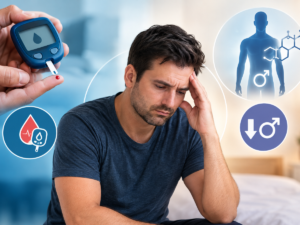
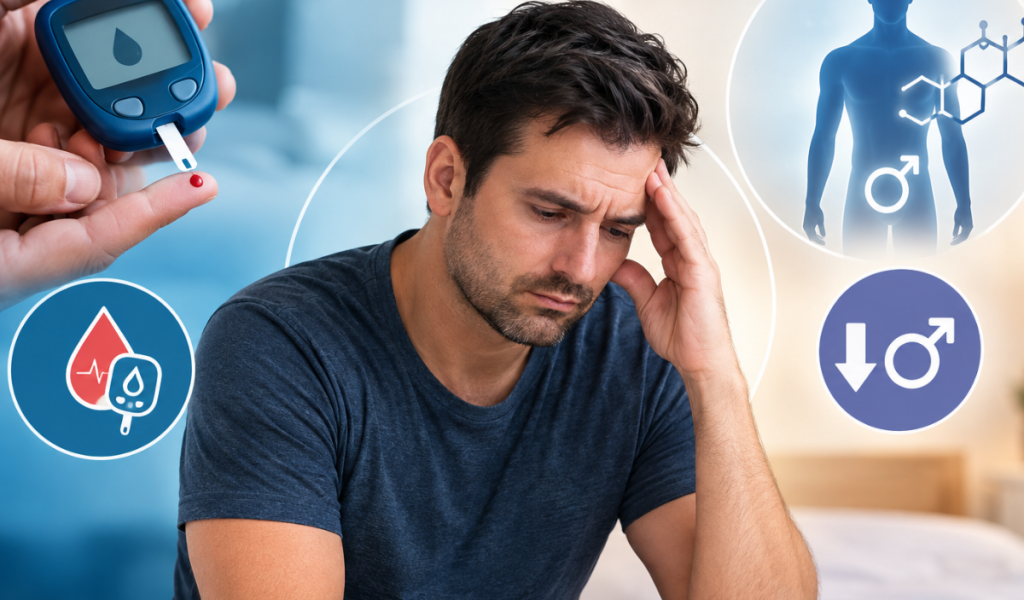
Type 2 diabetes and insulin resistance are associated with lower testosterone levels in men with a 30–50% prevalence of low testosterone (secondary hypogonadism) in diabetic men. The relationship is bidirectional: metabolic dysfunction lowers testosterone, and low testosterone can worsen body composition and insulin resistance.
Men with type 2 diabetes are more likely to develop low testosterone, particularly when insulin resistance, obesity, or excess abdominal fat is present. At the same time, low testosterone may contribute to increased body fat, reduced muscle mass, and changes in insulin sensitivity that can make blood sugar management more difficult. The two conditions often share several underlying metabolic factors.
Understanding there is a connection between diabetes and low testosterone can alert men to suspect low testosterone when they have symptoms such as fatigue, low sex drive, weight gain, or reduced muscle strength. This may warrant more than a simple blood sugar check. A more complete evaluation includes testosterone (free and total), LH, FSH, estradiol, DHEA, iron, ferritin, PSA and blood count. And, this is only a subset of a larger more complete routine panel from our office.
How Are Type 2 Diabetes and Low Testosterone Connected?
Insulin resistance, body fat, and ongoing inflammation can interfere with the hypothalamic pituitary axis (HPA) which signals the testes to make testosterone. These pituitary signals are luteinizing hormone (LH) and follicle stimulating hormone (FSH). The pituitary gland is located at the base of the brain extending from a stalk into the sella turcica. When low testosterone is caused by HPA dysfunction, this is called secondary hypogonadism. When testosterone levels drop, muscle mass tends to shrink and fat storage increases. This makes insulin resistance worse. All these factors work together to create a feed-back loop, a vicious cycle.
As mentioned above, Type 2 diabetes can contribute to dysfunction of the hypothalamic-pituitary-gonadal (HPG) axis, which regulates testosterone production. This communication system connects the brain and the testes, helping control the hormonal signals needed for normal testosterone production. When this axis is disrupted, LH and FSH signals may be insufficient, preventing the testes from producing adequate testosterone despite having normal testicular function.
This condition, known as secondary hypogonadism, is relatively common in men with Type 2 diabetes and can contribute to low testosterone in men with diabetes. Laboratory testing may reveal low testosterone alongside inappropriately low or normal LH and FSH levels, even when the testes are healthy. A comprehensive hormonal evaluation can also consider thyroid function, as normal TSH and thyroid health are relevant to understanding the broader hormonal picture and identifying other potential contributors to symptoms.
Why Does Insulin Resistance Lower Testosterone Levels?
Insulin resistance drives up circulating insulin, and high insulin levels reduce sex hormone-binding globulin (SHBG), a protein that carries testosterone through the bloodstream. Lower binding globulin changes how much testosterone is available and how the brain regulates production.
Chronic high blood sugar also raises inflammatory markers throughout the body. Inflammation suppresses luteinizing hormone, the pituitary signal that tells the testes to make testosterone. Over time, this suppression becomes a steady drag on hormone production rather than a temporary dip.
Diabetes and Low Testosterone. What is the Mechanism ?
The dominant pattern is hypogonadotropic (central) hypogonadism, with inappropriately normal or low LH/FSH rather than elevated gonadotropins (primary testicular failure is less common). Key contributing factors include:
Adiposity and aromatization: Excess visceral fat increases conversion of testosterone to estradiol via aromatase. Higher estradiol exerts negative feedback on the hypothalamic-pituitary-gonadal (HPG) axis, suppressing Gonadotropin releasing Hormone (GnRH), Luteinizing hormone (LH), and testicular testosterone production. (1)
Inflammation and adipokines: Pro-inflammatory cytokines (e.g., TNF-α, IL-1β, IL-6) from adipose tissue and insulin resistance suppress hypothalamic GnRH/kisspeptin neurons and can impair Leydig-cell function. Leptin resistance in obesity further disrupts central regulation of the HPG axis. (2)
Insulin resistance effects: Hyperinsulinemia and insulin resistance lower sex hormone-binding globulin (SHBG), reducing total testosterone; free testosterone also falls in more severe cases. There is evidence of reduced Leydig-cell responsiveness to LH and possible direct effects of hyperglycemia or mitochondrial dysfunction. (3)
Other contributors: Sleep apnea (common in this population), medications, and aging can amplify the effect. Acute hyperglycemia can also suppress testosterone acutely. Low testosterone then promotes further fat gain and muscle loss, creating a vicious cycle that worsens insulin resistance. (1-3)
How Does Lower SHBG Reduce Total Testosterone ?
Serum Hormone Binding Globulin (SHBG) binds to testosterone, making it less available. So how does lower SHGB reduce total testosterone? Higher SHBG binds more testosterone and thereby reduces the free (unbound) fraction. However, total testosterone equals free testosterone + albumin-bound testosterone + SHBG-bound testosterone. The HPA Gonadal axis primarily senses and regulates free (or bioavailable) testosterone through negative feedback.
When SHBG falls, the size of the bound testosterone “reservoir” shrinks. At steady state, total testosterone declines even when free testosterone is relatively preserved (or only modestly reduced). Testicular production does not automatically increase enough to keep total testosterone constant, because the regulated free fraction stays closer to its set-point until other factors (central suppression, inflammation, Leydig-cell effects) intervene.
Thus low SHBG commonly produces low total testosterone while free testosterone remains nearer normal, exactly the pattern often seen in men with obesity or type 2 diabetes until hypogonadism becomes more severe. (4-6)
How Common Is Low Testosterone in Men With Type 2 Diabetes?
30-40% of diabetic males have low testosterone, which is more common in men with type 2 diabetes than in men without diabetes. The connection is particularly strong in men who also have insulin resistance, obesity, excess abdominal fat, or other metabolic health concerns. However, 60-70% of diabetic males will have normal testosterone levels, so being diabetic does not automatically mean a man has low testosterone. (11-12)
The relationship between type 2 diabetes and low testosterone is complex. Diabetes and metabolic changes can interfere with the hormonal signals that regulate testosterone production. In some men, the problem involves reduced signaling from the brain and pituitary gland, while in others, the testes may not produce enough testosterone.
As several factors can cause low testosterone in men with diabetes, symptoms alone are not enough to determine whether testosterone levels are actually low. Proper evaluation typically involves reviewing symptoms, medical history, medications, and blood testosterone levels before determining whether further testing or treatment is appropriate.
How Is Low Testosterone Diagnosed in Men With Diabetes?
Diagnosis starts with a morning blood draw measuring total and free testosterone, since levels naturally peak earlier in the day. If a single low reading is not enough, many clinicians confirm with a second test and review symptoms before starting treatment.
Medical specialists check hemoglobin A1c, sex hormone-binding globulin, and luteinizing hormone to understand whether the problem originates in the testes or higher up in the brain’s signaling pathway. This distinction guides the treatment plan. Our page on the lab tests used to monitor testosterone therapy covers what these markers mean in more detail.
Can Treating Low Testosterone Improve Blood Sugar Control?
Restoring testosterone to a healthy range can improve insulin sensitivity, reduce visceral fat, and support lean muscle, all of which help regulate blood sugar. Muscle tissue absorbs much of the body’s glucose after a meal, so preserving and building muscle has a direct metabolic benefit.
However, testosterone therapy is not a substitute for diabetes management. Testosterone replacement therapy will improve blood sugar control. However, best results are obtained when testosterone therapy is used together with a diabetes management program which includes exercise, diet and lifestyle modification, and in some cases metformin is indicated.
Men considering this option should review our testosterone therapy services to understand what a full evaluation involves. (9)
What Lifestyle Changes Support Both Conditions at Once?
Several lifestyle changes can support testosterone levels and blood sugar control at the same time:
- Strength Training: Resistance exercises help build muscle, improve glucose uptake, and improve healthy testosterone levels. Aim for regular strength-training sessions each week.
- Healthy Weight Management: Losing excess weight, particularly visceral fat around the abdomen, improves insulin sensitivity and testosterone levels will also improve. Weight loss using diet modification or bariatric surgery significantly increases total and free testosterone in obese men, with greater rises linked to greater weight loss.
- Prioritize Quality Sleep: Poor sleep affects testosterone production and worsens insulin resistance. Aim for consistent, restorative sleep each night.
- Follow a Balanced Diet: Choose nutrient-dense foods that provide adequate protein, fiber, healthy fats, vitamins, and minerals to support metabolic and hormonal health.
- Stay Physically Active: Regular movement, including walking and other forms of aerobic exercise, can improve insulin sensitivity and complement a strength-training routine. (7-9)
Real Life Data from Dr. Haider in Germany
In 2016, Dr. Ahmad Haider conducted an observational registry study of 77 men with low testosterone. All the men had underlying cardiovascular disease. The 77 men were treated with long acting testosterone injections every 3 months and followed for 11 years. Not only were there no cardiovascular events in the testosterone treated group, various cardiovascular risk parameters and diabetic parameters improved. The treated men experienced significant weight loss, decreased waist circumference, improved glycemic control, and improvement in hemoglobin A1c which started at 7.1% and after 8 years on testosterone declined to 5.7%. Dr. Ahmad Haider writes:
Over 8 years, the men experienced weight loss (from 114 kg to 91 kg), decreased waist circumference (112 cm to 99 cm), decreased BMI from 37 to 29. Cardio-metabolic parameters such as lipid profile, glycemic control, blood pressure, heart rate, and pulse pressure all improved significantly and sustainably. No patient suffered a major adverse cardiovascular event during the full observation time. Testosterone therapy may be effective as an add-on treatment for secondary prevention of cardiovascular events in testosterone deficient men with a history of cardiovascular disease.
Mortality in men with TD [testosterone deficiency] was reduced subsequent to TTh [testosterone therapy]. [Molly] Shores et al. demonstrated that mortality in T-treated men was 10.3% compared with 20.7% in untreated hypogonadal men (P<0.0001). Muraleedharan et al. demonstrated, in hypogonadal men with type 2 diabetes mellitus, reduced mortality of 8.4% in men receiving TTh compared with 19.2% in untreated men. Note: TD=testosterone deficiency, TTh=Testosterone Therapy. (10)
Get Tested for Low Testosterone
Further evaluation of testosterone level in any diabetic male is justified, especially for diabetic men with fatigue, low libido, erectile difficulty, or unexplained muscle loss that does not improve with blood sugar control. Waiting years for the metabolic disorder to worsen with more severe symptoms is not advised, as the underlying insulin resistance becomes more difficult to reverse.
Type 2 diabetes and low testosterone rarely improve on their own once the vicious feedback cycle starts. Getting both conditions evaluated together, rather than treating one and hoping the other follows, gives a better chance for a good outcome with improvement in energy, improved fasting blood sugar and hemoglobin A1c diabetic markers.
If you have been managing diabetes and suspect low testosterone, reach out to our office to schedule an evaluation.
Frequently Asked Questions
Does type 2 diabetes cause low testosterone, or does low testosterone cause diabetes?
The relationship runs both directions. Insulin resistance and inflammation from diabetes lower testosterone production, while low testosterone increases fat mass and worsens insulin resistance, creating a vicious cycle.
Can losing weight raise testosterone in men with diabetes?
Yes, weight loss, especially loss of visceral fat, often improves testosterone levels by reducing inflammation and the conversion of testosterone into estrogen in fat tissue.
Is testosterone therapy safe for men with type 2 diabetes?
It can be appropriate for many men, but it requires proper diagnosis, monitoring, and coordination with diabetes management. A full evaluation determines whether testosterone therapy is right for you, based on your specific medical history, and laboratory testing. Our routine testing includes attention to cardiovascular health.
Can exercise alone fix low testosterone caused by diabetes?
Exercise is known to improve both testosterone levels and insulin sensitivity, but long-standing low testosterone often requires medical evaluation, testosterone therapy, exercise program, dietary, lifestyle changes. The first line medication for diabetes is a drug called metformin.
Articles with Related Interest:
Improve Insulin Resistance in Type Two Diabetes
Low Testosterone Diagnosis and Treatment
Testosterone Found Beneficial For Diabetes
Testosterone Reduces Mortality in Diabetic Males
References:
1. Dhindsa, Sandeep, et al. “Frequent Occurrence of Hypogonadotropic Hypogonadism in Type 2 Diabetes.” Journal of Clinical Endocrinology & Metabolism, vol. 89, no. 11, 2004, pp. 5462–5468.
2. Grossmann, Mathis. “Testosterone and Glucose Metabolism in Men: Current Concepts and Controversies.” Journal of Endocrinology, vol. 220, no. 3, 2014, pp. R37–R55.
3. Kapoor, D., et al. “Testosterone Replacement Therapy Improves Insulin Resistance, Glycaemic Control, Visceral Adiposity and Hypercholesterolaemia in Hypogonadal Men with Type 2 Diabetes.” European Journal of Endocrinology, vol. 154, no. 6, 2006, pp. 899–906.
4. Laaksonen, David E., et al. “Testosterone and Sex Hormone–Binding Globulin Predict the Metabolic Syndrome and Diabetes in Middle-Aged Men.” Diabetes Care, vol. 27, no. 5, 2004, pp. 1036–1041.
5. Grossmann, Mathis. “Low Testosterone in Men with Type 2 Diabetes: Significance and Treatment.” Journal of Clinical Endocrinology & Metabolism, vol. 96, no. 8, 2011, pp. 2341–2353.
6. Tsai, Elaine C., et al. “Association of Bioavailable, Free, and Total Testosterone with Insulin Resistance: Influence of Sex Hormone-Binding Globulin and Body Fat.” Diabetes Care, vol. 27, no. 4, 2004, pp. 861–868.
7. Grossmann, Mathis. “Low Testosterone in Men with Type 2 Diabetes: Significance and Treatment.” Journal of Clinical Endocrinology & Metabolism, vol. 96, no. 8, 2011, pp. 2341–2353.
8. Corona, Giovanni, et al. “Body Weight Loss Reverts Obesity-Associated Hypogonadotropic Hypogonadism: A Systematic Review and Meta-Analysis.” European Journal of Endocrinology, vol. 168, no. 6, 2013, pp. 829–843.
9. Wittert, Gary, et al. “Testosterone Treatment to Prevent or Revert Type 2 Diabetes in Men Enrolled in a Lifestyle Programme (T4DM): A Randomised, Double-Blind, Placebo-Controlled, 2-Year, Phase 3b Trial.” *The Lancet Diabetes & Endocrinology*, vol. 9, no. 1, 2021, pp. 32–45.
10. Haider, Ahmad, et al. “Men with testosterone deficiency and a history of cardiovascular diseases benefit from long-term testosterone therapy: observational, real-life data from a registry study.” Vascular health and risk management (2016): 251-261.
11. Dhindsa, Sandeep, et al. “Frequent Occurrence of Hypogonadotropic Hypogonadism in Type 2 Diabetes.” *Journal of Clinical Endocrinology & Metabolism*, vol. 89, no. 11, 2004, pp. 5462–5468.
12. Grossmann, Mathis, et al. “Low Testosterone Levels Are Common and Associated with Insulin Resistance in Men with Diabetes.” *Journal of Clinical Endocrinology & Metabolism*, vol. 93, no. 5, 2008, pp. 1834–1840.