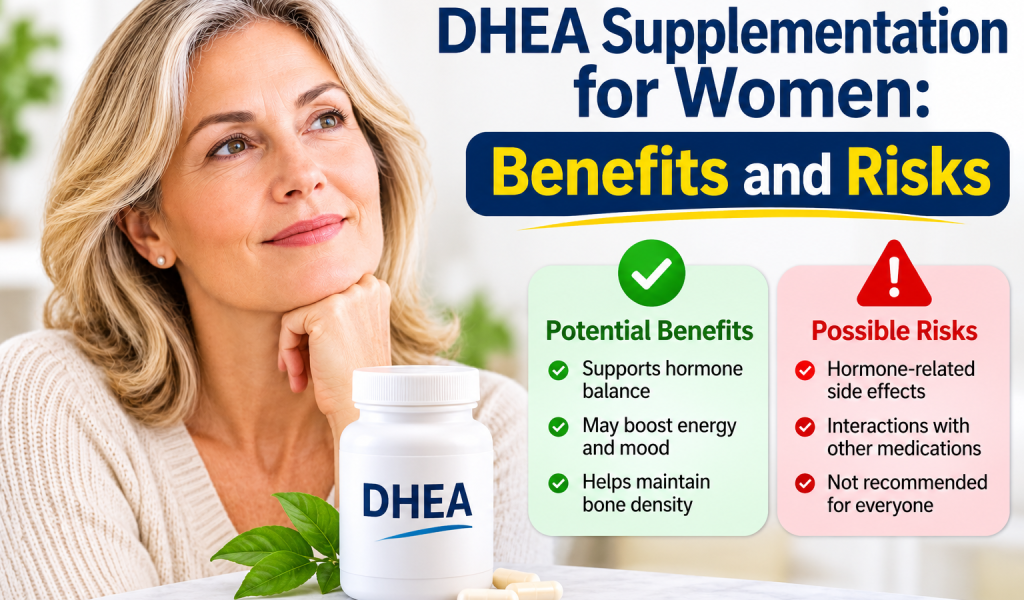
The DHEA bottle on the shelf promises more energy, a better libido, and younger skin. Is DHEA a miracle cure-all? Before you buy a DHEA supplement, let us ask the question: What is the medical evidence supporting all the health claims?
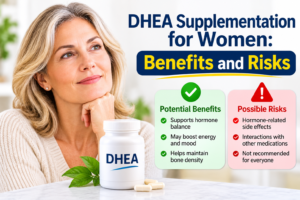
DHEA (di-hydro-epi-ando-sterone) is a hormone made by the adrenal glands which is converted into testosterone and estrogen. Clinical trial evidence for oral supplementation is modest and mixed. DHEA may help specific groups, but DHEA may have adverse effects of hirsutism, acne, excess facial hair, and hormone imbalance.
What DHEA Actually Does
In 1999, Dr. Wiebke Arlt and colleagues established that dehydroepiandrosterone (DHEA),, is a precursor hormone which is converted into androgens and estrogens as needed. Levels peak in our twenties and decline steadily with age. Restoring youthful higher levels of DHEA is thought to be anti-aging therapy, thus explaining all the anti-aging marketing. (1–3)
A gradually declining serum DHEA is a part of natural aging, and is not a disease. We usually measure serum DHEA-S, which may justify taking the supplement if levels are low for your age and associated with symptoms.
In my practice, we see low serum DHEA associated with adrenal stress or perimenopausal changes. See our discussions of adrenal involvement in the menopausal transition and cortisol testing options in the following articles:
Adrenal Insufficiency, HPA Dysfunction and Fatigue
Adrenal Fatigue the Ignored Epidemic of Modern Civilization
Adrenal Fatigue by Jeffrey Dach MD
Where the Evidence Is Strongest
- Painful sex after menopause: prescription vaginal DHEA, called prasterone, is FDA-approved for this. In 2018, Dr. Fernand Labrie confirmed significant improvements in dyspareunia, vaginal dryness, and tissue health with daily 6.5 mg intravaginal prasterone, with serum sex steroids remaining in the postmenopausal range. (4–6)
- Adrenal insufficiency: some women report better well-being and libido, though results across studies are inconsistent. In 1999, Dr. Wiebke Arlt showed 50 mg daily oral DHEA improved well-being and sexual interest in women with documented adrenal insufficiency. Later reviews note only small or inconsistent benefits for mood and quality of life. (1, 7–8)
- Poor ovarian response in fertility treatment: studies are mixed. For oral DHEA aimed at mood, bone density, or general vitality, trial results are modest at best. Claims about bone and muscle deserve extra skepticism, since the best evidence there is limited. Nobody should expect a hormone reset from a capsule. (9–11)
Who Should Consider DHEA
A few groups can justify taking DHEA. Women with diagnosed adrenal insufficiency are one group that benefit from DHEA supplementation. Postmenopausal women with painful sex may be offered prescription vaginal prasterone (DHEA). Some women undergoing fertility treatment use DHEA as suggested by their reproductive specialist.
Who Should Not Use DHEA
Women with polycystic ovary syndrome (PCOS), with high androgen levels, or with hormone-sensitive cancer generally should not take DHEA. Our articles on PCOS Part One and PCOS Part Two explain that many women with PCOS already have elevated DHEA-S and androgens from ovarian or adrenal sources; adding more can worsen acne, hirsutism, and anovulation. Non-classical congenital adrenal hyperplasia (CAH) can have a similar presentation and requires proper testing rather than DHEA supplementation.
Risks and Side Effects Worth Knowing
Because DHEA converts to androgens, side effects often look like excess androgens:
- Acne and oily skin
- Scalp hair thinning or new facial hair
- Mood changes and irritability
- Lower HDL cholesterol
- Deepening voice at high doses
Women with PCOS often already run high DHEA-S, so adding more can backfire. Our article on PCOS and insulin resistance explains that hormone pattern. Anyone with a hormone-sensitive cancer should avoid DHEA unless the oncologist is in agreement.
DHEA supplements are available at the vitamin store, and therefore not required to be FDA-approved. There may be some variation in strength, and the labelling may differ from the actual product in the bottle, so make sure to use a high quality brand that uses third party testing.
Dosing and Quality Problems
Over-the-counter products vary widely in strength, and labels do not always match contents. Higher doses push androgen levels up faster. Competitive athletes should also know that DHEA is prohibited under anti-doping rules.
If a clinician does recommend a DHEA supplement, women should expect follow-up testing within the first few months, and a plan to stop if levels climb or side effects appear.
A DHEA-S blood test alongside testosterone and estradiol, shows whether a supplement makes sense at all. Adrenal hormones also run together, so cortisol context helps. Our guide to cortisol testing options compares the methods.
What to Do NEXT?
Not sure where your levels sit? We start with a full history, physical examination and laboratory testing through Quest or Labcorp before suggesting any plan. See our services page for more information. If you are interested in our program at the TruemedMD clinic in Davie, Florida, use the contact page to inquire or schedule a consultation.
Signs You Should Stop and Call
Stop the supplement and contact your clinician if you notice:
- New or worsening acne
- Unusual hair growth or scalp hair loss
- A lowering of your voice
- Irregular bleeding or marked mood swings
What to Check Before Blaming DHEA
If fatigue is the real complaint, thyroid function, serum iron, ferritin, B12, sleep, and the perimenopause transition often explain it better than low DHEA. Several hormones usually shift all at once during the perimenopausal transition. See our article on weight gain and hormonal changes after 40 for more on this topic.
Women may have seen a DHEA supplement advertised as an energy fix. However, taking DHEA can mask the real cause and add side effects on top of it.
How DHEA Fits With Other Hormones
DHEA does not act alone. It feeds the same steroidal pathway as testosterone, estradiol, and cortisol, so changing one input can shift the others. A woman with low estrogen after menopause, for example, may see symptoms that DHEA cannot fix.
That is why symptoms like fatigue, low libido, and mood changes need a wider investigation. Thyroid, cortisol, sex hormones, and sleep all belong in the same conversation.
Smart Questions Before You Buy
- Has my DHEA-S actually been tested, and was it low for my age?
- Do I have PCOS, acne, or a hormone-sensitive condition?
- Which brand is independently tested for purity and strength?
- When will we recheck my DHEA levels, and when so we stop?
Pregnancy, Breastfeeding, and Younger Women
DHEA is not recommended during pregnancy or breastfeeding, because extra androgens can affect a developing baby. Younger women with normal levels have no clear reason to take it, and the acne and hair side effects tend to show up sooner. If you are trying to conceive, bring the topic to a fertility specialist before starting anything.
Frequently Asked Questions
Is DHEA safe for women to take daily?
Many women tolerate low doses, but long-term safety data are limited, so medical supervision and lab monitoring matter.
Does DHEA help menopause symptoms?
Prescription vaginal DHEA helps painful sex after menopause. Oral DHEA has not shown reliable benefit for hot flashes.
Can DHEA cause hair loss or acne?
Yes. Because it converts to androgens, DHEA can cause acne, oily skin, and thinning of scalp hair.
Should women with PCOS take DHEA?
No, not without serum DHEA-S testing. Many women with PCOS already have elevated DHEA-S.
How do I know if my DHEA is low?
A DHEA-S blood test shows your level. Results should be interpreted on the basis of your age and symptoms.
Articles with Related Interest:
Adrenal Insufficiency, HPA Dysfunction and Fatigue
Adrenal Fatigue the Ignored Epidemic of Modern Civilization
Adrenal Fatigue by Jeffrey Dach MD
Menopausal Hormone Replacement Health Benefits
References
1. Arlt, Wiebke, et al. “Dehydroepiandrosterone Replacement in Women with Adrenal Insufficiency.” New England Journal of Medicine, vol. 341, no. 14, 1999, pp. 1013–20.
2. Labrie, Fernand, et al. “DHEA and the Intracrine Formation of Androgens and Estrogens in Peripheral Target Tissues: Its Role during Aging.” Steroids, vol. 63, no. 5–6, 1998, pp. 322–28.
3. Orentreich, Norman, et al. “Age Changes and Sex Differences in Serum Dehydroepiandrosterone Sulfate Concentrations throughout Adulthood.” Journal of Clinical Endocrinology & Metabolism, vol. 59, no. 3, 1984, pp. 551–55.
4. Labrie, Fernand, et al. “Efficacy of Intravaginal Dehydroepiandrosterone (DHEA) on Moderate to Severe Dyspareunia and Vaginal Dryness, Symptoms of Vulvovaginal Atrophy, and of the Genitourinary Syndrome of Menopause.” Menopause, vol. 25, no. 11, 2018, pp. 1339–53.
5. Archer, David F., et al. “Treatment of Pain at Sexual Activity (Dyspareunia) with Intravaginal Dehydroepiandrosterone (Prasterone).” Menopause, vol. 22, no. 9, 2015, pp. 950–63.
6. U.S. Food and Drug Administration. “FDA Approves Intrarosa for Postmenopausal Women Experiencing Pain during Sex.” 2016.
7. Alkatib, Ayman A., et al. “A Systematic Review and Meta-Analysis of Randomized Placebo-Controlled Trials of DHEA Treatment Effects on Quality of Life in Women with Adrenal Insufficiency.” Journal of Clinical Endocrinology & Metabolism, vol. 94, no. 10, 2009, pp. 3676–81.
8. Wierman, Margaret E., and Katja Kiseljak-Vassiliades. “Should Dehydroepiandrosterone Be Administered to Women?” *Journal of Clinical Endocrinology & Metabolism*, vol. 107, no. 6, 2022, pp. 1679–85.
9. Elraiyah, Tarig, et al. “Clinical Review: The Benefits and Harms of Systemic Dehydroepiandrosterone (DHEA) in Postmenopausal Women with Normal Adrenal Function: A Systematic Review and Meta-Analysis.” Journal of Clinical Endocrinology & Metabolism, vol. 99, no. 10, 2014, pp. 3536–42.
10. Panjari, Mary, and Susan R. Davis. “DHEA for Postmenopausal Women: A Review of the Evidence.” *Maturitas*, vol. 66, no. 2, 2010, pp. 172–79.
11. Narkwichean, Amarin, et al. “Efficacy of Dehydroepiandrosterone to Improve Ovarian Response in Women with Diminished Ovarian Reserve: A Meta-Analysis.” *Reproductive Biology and Endocrinology*, vol. 11, 2013, article 44.