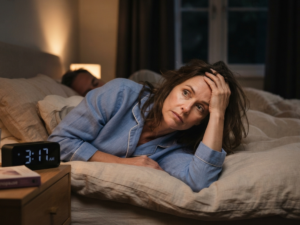

How Does Perimenopause Cause Insomnia?
Insomnia is a common complaint in women undergoing the perimenopausal transition because of fluctuating reproductive hormones which disturb sleep regulation and temperature regulation. In addition, there may be mood disturbance, and irregular menstrual cycle.
Estrogen and progesterone are not in a gradual, steady decline during this transition phase called perimenopause. Instead, there is a very low or absent progesterone level, while estrogen can fluctuate wildly up and down. These estrogen and progesterone changes may coincide with disturbance in sleep or poor quality sleep. Some women notice they have more difficulty staying asleep even before their menstrual periods become irregular. These hormonal changes can vary from woman to woman undergoing the menopause transition called perimenopause.
Hot flashes, night sweats, anxiety, depression, stress, pain, medications, changes in sleep schedules, and underlying sleep disorders can all contribute to insomnia during perimenopause.
How Do Hormonal Changes Affect Sleep During Perimenopause?
Hormonal fluctuations can affect several processes that influence sleep, including temperature regulation and mood. Estrogen receptors are found in hypothalamic and brainstem regions that that regulate sleep and wakefulness. This includes brain’s master clock located in the preoptic area. Through these regions and pathways in the brain, estrogen help to fall asleep, and then maintenance sleep. Estrogen is also involves with the small drop in core body temperature that normally precedes and sustains sleep.
When estrogen levels fluctuate, some women experience vasomotor symptoms such as hot flashes and night sweats that interrupt sleep.
Ovulation is intermittent or stops altogether during the peri-menopausal transition. This causes progesterone levels to be low or absent during the menopause transition. Progesterone is a neurosteroid which calms the central nervous system through modulation of GABA receptors. Thus, low or absent progesterone levels may coincide with changes in sleep patterns in perimenopausal women. As mentioned above, fluctuations in estrogen levels may also contribute to changes in sleep patterns and overall comfort during this transition stage.
There is considerable variability. Some women experience significant sleep disruption, while others have relatively few sleep-related symptoms despite going through the same reproductive transition. Read this article for more information about the full range of perimenopause and menopause symptoms that women experience.
How Do Hot Flashes and Night Sweats Disrupt Sleep?
Hot flashes and night sweats are common reasons women report sleep disturbances during perimenopause.
A hot flash can cause a sudden sensation of heat and sweating that wakes you from sleep. Night sweats may leave you uncomfortable enough to change clothing or bedding before resuming sleep. Repeated episodes can fragment sleep and reduce the amount of restorative sleep you get.
Sleep may also remain disrupted even when hot flashes are not so obvious. Some women experience frequent nighttime awakenings or wake early in the morning without recognizing a specific physical trigger. If hot flashes are a driving factor, the route of estrogen delivery, whether oral pill, or topical patch, or cream, can influence the response to treatment, in other words, how well sleep improves.
Why Am I Waking Up at Night During Perimenopause?
Waking up at night during perimenopause can be related to hormonal fluctuations, hot flashes, night sweats, anxiety, stress, pain, medications, thyroid dysfunction, or other underlying sleep disorders.
The pattern of sleep disruption can provide useful information. For example, waking at 3 a.m. may occur during perimenopause, and the patient may seek relief with natural progesterone which calms the brain and allows for a good night’s sleep.
Can Low Estrogen Cause Insomnia During Perimenopause?
Estrogen fluctuations can be associated with vasomotor symptoms, including hot flashes and night sweats, which can interrupt sleep. Changes in mood and other symptoms of the menopause transition may also make restful sleep more difficult.
At the same time, sleep disruption can have other causes unrelated to estrogen. Thyroid conditions, various stimulant medications, anxiety, depression, chronic pain, restless legs syndrome, and sleep apnea can all affect sleep.
What Can We Do For Sleep Problems During Perimenopause?
Maintaining a consistent sleep and wake schedule, keeping the bedroom comfortable and cool, exercising regularly, limiting caffeine later in the day, and developing a relaxing bedtime routine can support better sleep.
Although mainstream medicine relies heavily on sedative sleeping pills, we do not recommend that approach because sleeping pills are dangerous. They are chemically addictive and lead to increased mortality. For more on the dangers of sleeping pills see this article: The Dangers and Risks of Sleeping Pills.
If hot flashes and night sweats are contributing to disrupted sleep, treating those menopausal symptoms may also improve sleep. Natural progesterone be appropriate for women experiencing insomnia. For women who prefer not to use natural progesterone, some conventional doctors may offer sleeping pills or non-hormonal drugs for perimenopause and menopause. To learn why this is not recommended, read this article: . To learn why, read this article:The Dangers of Non-Hormonal Drugs for Menopause Symptoms.
Instead of sedative sleeping pills and other non-hormonal drugs, the most appropriate treatment is natural progesterone which acts on GABA receptors to calm the brain.
For chronic insomnia, cognitive behavioral therapy is considered a first-line treatment. It focuses on the behaviors and thought patterns that can maintain insomnia.
Perimenopause Sleep Treatment, Avoid Sleeping Pills, Use Natural Progesterone Instead.
For the perimenopausal woman with chief complaint of insomnia, the mainstream medical doctors will offer sleeping pills such as the “Z drugs”, Zaleplon (Sonata), Zolpidem (Ambien), Zopiclone (Imovane). Sleeping pills are not recommended because they are dangerous. They are chemically addictive and are associated with increased mortality. For more on the dangers of sleeping pills, see: The Dangers of Sleeping Pills.
In some cases, mainstream medical doctors will offer the perimenopausal woman with sleep problems an SSRI antidepressant. This is the wrong treatment and is to be avoided. To learn more adverse effects and lack of efficacy of SSRI antidepressants, see this article: The Depressing State of Antidepressants.
Instead of sleeping pills, or SSRI antidepressants, our TruemedMD clinic offers natural progesterone which helps the perimenopausal women with sleep. In 2021, Dr. B.J. Nolan reviewed nine randomized controlled trials with 388 post menopausal women using progesterone for sleep, finding micronized progesterone improves various sleep outcomes in randomized controlled trials, predominantly in studies enrolling postmenopausal women. Dr. Nolan attributes the sleep benefits of progesterone to progesterone metabolites which improve sleep parameters through positive modulation GABA Type A Receptors. (1-11)
In 2011, Dr. Jerilynn Prior, a professor of endocrinology from Canada wrote a paper entitled, Progesterone for Symptomatic Perimenopause (2011), Click here to read the pdf article. Dr. Prior states that Progesterone is an excellent treatment for perimenopausal symptoms. About 80% of perimenopausal women suffer vasomotor symptoms (hot flashes, night sweats), 25% menorrhagia, 10% mastalgia, sleep (insomnia), coping, and mood difficulties.
Contact Us for Perimenopausal Insomnia Evaluation
At our TruemedMD Clinic in Davie, Florida, our medical director, Jeffrey Dach MD provides individual attention and a full evaluation for women experiencing insomnia and other hormone-related symptoms during the menopausal transition (perimenopause). Evaluation includes a complete medical history, physical examination and laboratory studies. This includes attention to symptoms, menstrual patterns, medical history, risk factors, and, laboratory findings as part of our bioidentical hormone replacement services.
Rather offering sleeping pills or SSRI anti-depressants, natural progesterone is the mainstay treatment of choice during the perimenopausal transition, and most women report it is helpful with insomnia and other perimenoausal symptoms. Contact TruemedMD at our Davie, Florida office to schedule a consultation.
Frequently Asked Questions
Is insomnia common during perimenopause?
Yes. Sleep problems can become more common during the menopause transition. Hormonal fluctuations, hot flashes, night sweats, mood changes, stress, and other health or sleep conditions can all contribute to disrupted sleep.
Why does perimenopause cause insomnia?
Perimenopause may affect sleep through fluctuating estrogen levels and very low or absent progesterone levels, changes in temperature regulation, hot flashes, night sweats, and mood symptoms. Other causes of insomnia should also be considered.
Why do I wake up at 3 a.m. during perimenopause?
Waking at 3 a.m. can occur during perimenopause. Night sweats, anxiety, stress, sleep apnea, medications, thyroid and adrenal problems, among other things, can cause early morning waking.
Can low estrogen cause sleep problems during perimenopause?
Yes. Perimenopause is characterized by low or absent progesterone levels and dramatic fluctuations in estrogen levels. These hormonal changes are strong contributors to sleep disruption, particularly when they are associated with hot flashes or night sweats. Supplementing with natural progesterone usually provide relief during the perimenopausal transition.
Articles with Related Interest:
Safety and Adverse Effects of Natural Progesterone, Part One
The Dangers of Non-Hormonal Menopause Drugs
FDA Approval for Paxil for Hot Flashes A Cruel Joke
Lexapro for Hot Flashes – Medical Victimization or a Joke?
The Depressing State of Antidepressants
Menopausal Hormone Replacement Health Benefits
Diagnosis and Treatment of Premenstrual Syndrome Part Three
Progesterone for Symptomatic Perimenopause (2011), Click here to read the pdf article. by Dr. Jerilynn Prior
References:
- Nolan, B. J., B. Liang, and A. S. Cheung. “Efficacy of Micronized Progesterone for Sleep: A Systematic Review and Meta-analysis of Randomized Controlled Trial Data.” The Journal of Clinical Endocrinology and Metabolism 106.4 (2021): 942-951.
- Hachul, Helena, et al. “Sleep During Menopause.” Sleep Medicine Clinics 18.4 (2023): 423-433.
- Bashir, Kiran, et al. “Prevalence of Insomnia in Menopausal Women: Prevalence of Insomnia.” Pakistan Journal of Health Sciences (2023): 43-46.
- Caretto, Marta, Andrea Giannini, and Tommaso Simoncini. “An integrated approach to diagnosing and managing sleep disorders in menopausal women.” Maturitas 128 (2019): 1-3.
- Lee, Jinju, et al. “Sleep disorders and menopause.” Journal of Menopausal Medicine 25.2 (2019): 83-87.
- Li, Caixia, et al. “Analysis of the long‑term beneficial effects of menopausal hormone therapy on sleep quality and menopausal symptoms.” Experimental and Therapeutic Medicine 18.5 (2019): 3905-3912.
- Andenæs, Randi, et al. “Associations between menopausal hormone therapy and sleep disturbance in women during the menopausal transition and post-menopause: data from the Norwegian prescription database and the HUNT study.” BMC women’s health 20.1 (2020): 1-9.
- Pan, Zhuo, et al. “Different regimens of menopausal hormone therapy for improving sleep quality: a systematic review and meta-analysis.” Menopause (New York, NY) 29.5 (2022): 627.
- Dias, Rejane Camila Alvarenga, et al. “Fibromyalgia, sleep disturbance and menopause: Is there a relationship? A literature review.” International Journal of Rheumatic Diseases 22.11 (2019): 1961-1971.
- Zhou, Qian, et al. “Investigation of the relationship between hot flashes, sweating and sleep quality in perimenopausal and postmenopausal women: the mediating effect of anxiety and depression.” BMC Women’s Health 21.1 (2021): 1-8.
- Kagan, Risa, et al. “Improvement in sleep outcomes with a 17β-estradiol–progesterone oral capsule (TX-001HR) for postmenopausal women.” Menopause (New York, NY) 26.6 (2019): 622.