What is PCOS? A metabolic disorder called insulin resistance is commonly seen in polycystic ovary syndrome (PCOS). However, the main abnormality in PCOS syndrome is anovulation, elevated testosterone and insulin resistance. The pancreas compensates by producing more insulin to help regulate blood glucose. These elevated insulin levels can affect ovarian function and stimulate increased testosterone production with androgenic effects of hirsutism and acne. Note: ovulation is when the egg ruptures from the ovarian follicle and starts its long trip down the fallopian tube. The fertilized egg then finally implants within the endometrial cavity. As you might think, ovulation is required for fertility.
The hallmark of PCOS is anovulation (lack of ovulation) with irregular periods, acne, excess hair growth, and either infertility or difficulty conceiving. In addition, ongoing insulin resistance increases the risk of prediabetes and type 2 diabetes.
Let us review how insulin, blood sugar, and reproductive hormones all interact in the PCOS patient, and how diet and lifestyle modifications together with metformin can help.
What Is the Connection Between PCOS and Insulin Resistance?
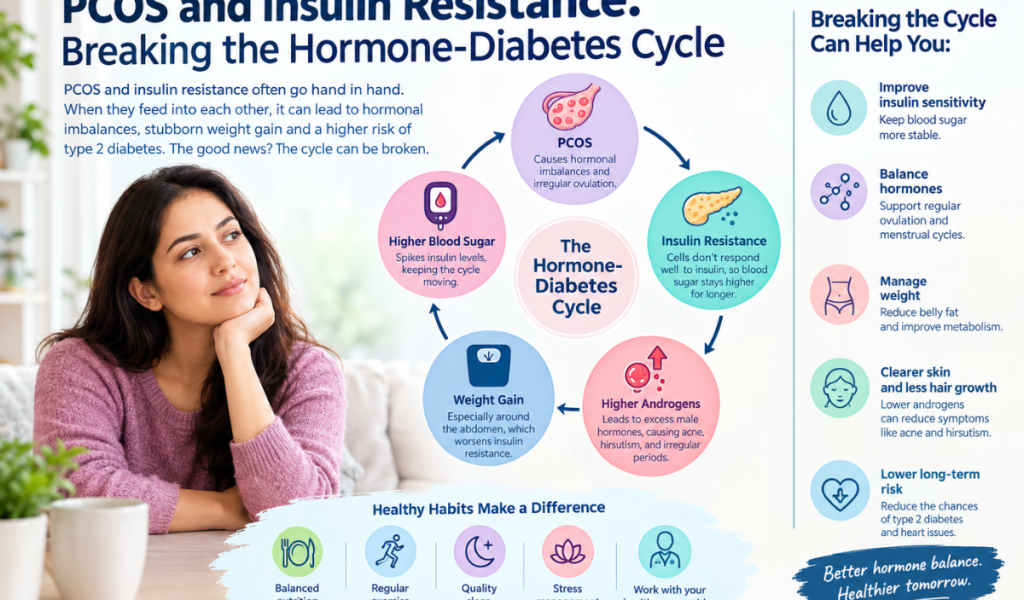
Polycystic ovary syndrome (PCOS) is a hormonal and metabolic condition that affects ovulation, menstrual cycles, androgen levels, and blood sugar regulation.
Insulin resistance occurs when the body’s cells do not respond properly to insulin. Insulin helps glucose move from the bloodstream into cells, where it is used for energy. When insulin resistance develops, the pancreas will compensate by producing more insulin, creating a state of hyperinsulinemia with elevated insulin levels.
In women with PCOS, insulin resistance is quite common, but some women with PCOS are spared and have normal blood sugar. Does obesity determine who will have insulin resistance? Yes, obesity is associated with metabolic syndrome and insulin resistance, so this does play a role. However, there is considerable variation.
Elevated insulin affects both blood sugar metabolism and reproductive hormones. Elevated insulin levels stimulate the ovaries to produce more androgens, including testosterone, thus causing androgenic symptoms of acne and hirsutism (facial hair).
Insulin resistance occurs when the body’s cells have a reduced response to insulin, a hormone that helps regulate blood glucose levels. In response, the pancreas compensates by secreting more insulin, a condition known as hyperinsulinemia. In this scenario, peripheral tissues, including muscle and adipose tissue, have impaired insulin-mediated glucose uptake. This stimulates the pancreatic beta cells to increase insulin production to maintain normal blood glucose levels (euglycemia). Eventually, the beta cells may no longer be able to compensate adequately, leading to elevated blood glucose levels. Understanding the connection between insulin resistance and hormonal health is important because insulin plays a key role in metabolic function and interacts with other hormonal pathways throughout the body.
Insulin resistance is common in PCOS, yet some women have normal blood glucose.
Estimates of insulin resistance in PCOS typically range from roughly 50–95 %. Many affected women remain euglycemic, with a normal serum glucose, because of compensatory hyperinsulinemia. A subset of PCOS patients will later develop type 2 diabetes, after the pancreas loses the ability to compensate.
Body weight does not fully determine who develops insulin resistance; it occurs in both higher-weight and lean women. Studies demonstrated insulin resistance in both obese and non-obese PCOS women, although prevalence and severity are usually higher in obese PCOS patients. Obesity and visceral adiposity amplify the problem.
Elevated insulin can increase ovarian testosterone production and thereby worsen PCOS symptoms. Ovarian theca cells are very sensitive to insulin which stimulates produciton of androgens, testosterone and androstenedione. What is the mechanism? Insulin’s action on the ovary is similar to Luteinizing Hormone (LH) which increases CYP17 enzyme activity and androgen biosynthesis. At the same time, insulin lowers hepatic serum hormone binding protein (SHBG), raising free testosterone. This creates a feed-forward loop between hyperinsulinemia and hyperandrogenism. (1-18)
How Does Insulin Resistance Affect PCOS Hormones?
Insulin resistance can influence several hormonal processes involved in PCOS. Higher insulin levels may contribute to:
- Increased Androgen Production: Elevated insulin can encourage the ovaries to produce more androgens, including testosterone.
- Lower SHBG levels: High insulin may reduce sex hormone-binding globulin (SHBG), increasing free testosterone in the bloodstream. Note: SHBG is serum hormone binding globulin.
- Irregular Ovulation: Changes in insulin and androgen levels can interfere with normal ovulation and contribute to irregular menstrual cycles.
- Menstrual Irregularity: When there is long term anovulation, menstrual periods may become infrequent, unpredictable, or absent.
- Fertility Problems: Irregular ovulation and anovulation associated with PCOS and insulin resistance creates fertility problems, and difficulty with conception. (1-18)
The connection between insulin resistance, hyperandrogenism, and PCOS symptoms makes metabolic health a key element in PCOS management.
What Happens to Estrogen Production in PCOS?
What happens to ovarian estrogen production in the PCOS patient? There are two steps in the production of estrogen. The step is the ovary makes testosterone. The second step is conversion of testosterone to estrogen by the aromatase enzyme.
In the first step, ovarian theca cells make androgens, androstenedione and testosterone under stimulation by leuteinizing hormone (LH). In the second step, ovarian granulosa cells use the aromatase enzyme to convert the androgens to estrogens, mainly to estradiol. This is stimulated by follicle stimulating hormone (FSH).
Elevated insulin acts like LH stimulation on ovarian theca cells. The result is more androgen production acting as substrate leaving the theca compartment for conversion to estrogen by the granulosa cells.
Elevated insulin also stimulates granulosa cells, increasing their activity on this increased androgen substrate can therefore increase the capacity for estrogen synthesis. However, in PCOS patients we have a different picture which is explained below.
First, Let Us Explain AMH
What is AMH? AMH stands for Anti-Müllerian Hormone, a granulosa-cell hormone from small growing follicles. This AMH restrains FSH action and aromatase activity until a follicle is ready to be selected. In PCOS, AMH restraint is excessive, so follicles stay small and androgen-rich. Even though these follicles are androgen rich, there is poor aromatase conversion to estrogen from circulating AMH secreted by a large number of small follicles.
In PCOS, the ovarian follicles are typically arrested at the small-antral stage. This means the ovarian follicles pile up around 2–8 mm in size and fail to become a selected dominant follicle. This creates the “string of pearls” image seen on ultrasound of the ovary. The early follicles are arrested and no dominant follicle is selected for ovulation. Ovulation does not take place.
There is relative FSH deficiency (high LH:FSH ratio), high intrafollicular AMH, and an androgen-dominant microenvironment which limits full aromatase induction that would occur in a growing dominant follicle.
Arrested follicles therefore convert only a fraction of the excess theca androgens to estradiol. The ovary as a whole often still produces a normal or modestly elevated amount of estrogen because many small follicles contribute and because extra-ovarian aromatization of androgens from adipose tissue raises circulating estrone. Circulating estradiol is therefore usually not low, but it is unopposed by cyclic progesterone because of anovulation. The intraovarian environment remains androgen-dominant rather than estrogen-dominant.
Metformin is a first line anti-diabetic drug commonly used in PCOS. Metformin is useful here by lowering serum insulin which reduces both androgen output and FSH-stimulated aromatase production of estrogen. Since insulin stimulates both theca androgen production and granulosa estrogen-producing capacity, this makes metformin a very useful intervention.
The net clinical effect of the insulin–androgen loop is hyperandrogenism, anovulation, and PCOS symptoms. The feed-forward loop is bidirectional: increased androgens can worsen insulin resistance, which further raises insulin and free testosterone. (19-24)
What Causes Anovulation in PCOS?
PCOS anovulation is a failure of selection of the dominant follicle, not a failure of the ovary to make estrogen. The ovary makes extra androgen, yet only partially aromatizes the androgens to estrogen. At the same time, Anti-Mullerian Hormone (AMH) keeps the follicles small while high insulin and high LH stimulates androgen levels further. Lowering insulin with diet and lifestyle, metformin, and/or raising effective FSH action with an aromatase inhibitor (letrozole) and exogenous FSH can break the cycle and restart ovulation. (25-31)
Can PCOS and Insulin Resistance Cause Diabetes?
PCOS increases the risk of prediabetes and type 2 diabetes, particularly when insulin resistance is present.
Initially, the pancreas may produce enough insulin to keep blood glucose within normal range. However, over time, the body may not be able to compensate for the insulin resistance by increasing pancreatic Beta cell insulin production. Blood sugar can then rise, leading to prediabetes or diabetes.
Women with PCOS may have an increased risk of diabetes even when they do not have obvious symptoms of high blood sugar.
What Are the Signs of Insulin Resistance in Women With PCOS?
Insulin resistance often develops without clear symptoms. Some women discover it through blood tests rather than physical changes. Possible signs and associated risk factors include:
- Acanthosis nigricans, or darkened, thickened skin around the neck, armpits, or groin.
- Weight gain or increased waist circumference.
- Elevated fasting blood glucose or hemoglobin A1C.
- Abnormal cholesterol or triglyceride levels.
- A family history of type 2 diabetes.
- Existing PCOS symptoms, such as irregular periods.
These signs are suggestive, but confirmation insulin resistance requires additional testing. A healthcare professional may recommend the hemoglobin A1C test, fasting glucose, or an oral glucose tolerance test (OGTT) to evaluate blood sugar regulation.
How Can You Improve Insulin Sensitivity With PCOS?
Managing PCOS insulin resistance involves improving metabolic health while addressing hormonal symptoms and individual treatment goals.
Focus on Balanced Nutrition
A balanced eating pattern can support blood sugar control and insulin sensitivity.
Include:
- High-fiber vegetables.
- Whole grains and other minimally processed carbohydrates.
- Protein-rich foods.
- Healthy fats.
- Adequate hydration with water and other fluids.
Pairing carbohydrates with protein and fiber may help create satisfying meals and support steadier blood sugar responses. You do not need to eliminate carbohydrates completely.
Exercise Regularly
Physical activity helps muscles use glucose more effectively, which can improve insulin sensitivity.
A combination of walking, aerobic exercise, and strength training may support blood sugar regulation, cardiovascular health, and overall well-being.
You do not need to start with intense workouts. Consistency matters more than choosing an exercise routine that is hard to maintain.
Prioritize Sleep and Stress Management
Poor sleep and chronic stress can affect metabolic health, appetite, and daily energy levels.
Maintaining a regular sleep schedule and practicing stress-management techniques may support your overall health. These habits should complement, not replace, medical treatment.
Discuss Treatment Options with your Doctor
Lifestyle changes are important, but some women may also benefit from medication.
Metformin is an insulin-sensitizing medication commonly used to treat type 2 diabetes. It may also be prescribed for women with PCOS, particularly when insulin resistance and elevated fasting blood sugar are present.
Other treatments such as letrozole and myoinositol may be considered for menstrual irregularity, androgen-related symptoms, or fertility concerns.
Can Treating Insulin Resistance Improve Fertility?
In patients with PCOS, insulin resistance can cause anovulation which contributes to infertility. When insulin resistance and related hormonal disturbances are addressed, some women may experience improved menstrual regularity and improvement in ovulatory function.
However, improving insulin sensitivity does not guarantee pregnancy. Fertility depends on several factors, including ovulation, reproductive health, and the health of both partners.
Women with PCOS trying to conceive and interested in ovulation-inducing medication should consult a reproductive endocrinologist. Treatment options include Letrozole, Clomid, Metformin, myoinositol and various others.
Trust an Ideal Professional
At the TruemedMD clinic, our medical director, Jeffrey Dach MD, provides integrative and preventive medicine services focused on individualized patient care. We specialize in bioidentical hormones, natural thyroid, and integrative medicine.
If you are experiencing PCOS symptoms, insulin resistance, or concerns about blood sugar, we can help. Contact the office to make an appointment. To learn more click here: Learn more about Jeffrey Dach MD.
Frequently Asked Questions
What is the connection between PCOS and insulin resistance?
In patients with PCOS, insulin resistance occurs when the body does not respond effectively to insulin. This can cause higher insulin levels, which may increase androgen production and contribute to irregular periods, ovulation problems, and a higher risk of prediabetes and type 2 diabetes.
Can insulin resistance make PCOS symptoms worse?
Yes. Elevated insulin levels can stimulate androgen production and lower sex hormone-binding globulin (SHBG). This may worsen symptoms such as irregular periods, acne, excess facial hair, and difficulty with ovulation.
How do I know if I have insulin resistance with PCOS?
Insulin resistance may not cause noticeable symptoms. Your healthcare provider may evaluate your metabolic health using tests such as hemoglobin A1C, fasting blood glucose, or an oral glucose tolerance test (OGTT), depending on your individual risk factors.
Can PCOS insulin resistance lead to type 2 diabetes?
PCOS is associated with an increased risk of prediabetes and type 2 diabetes, particularly when insulin resistance is present. Regular blood sugar screening can help identify metabolic changes early.
Articles with Related Interest:
PCOS, the Hidden Epidemic Part Two
PCOS, BPA and Endocrine Disruptors, Part Three
How to Improve Insulin Resistant Diabetes
Metformin the Anti-Aging Miracle Drug
References:
- Teede, Helena J., et al. “Recommendations From the 2023 International Evidence-based Guideline for the Assessment and Management of Polycystic Ovary Syndrome.” The Journal of Clinical Endocrinology & Metabolism, vol. 108, no. 10, 2023, pp. 2447–2469.
- World Health Organization. “Polycystic Ovary Syndrome.” WHO Fact Sheet, 22 Jan. 2026.
- Dunaif, Andrea. “Insulin Resistance and the Polycystic Ovary Syndrome: Mechanism and Implications for Pathogenesis.” *Endocrine Reviews*, vol. 18, no. 6, 1997, pp. 774–800.
- Zhao, Han, et al. “Insulin Resistance in Polycystic Ovary Syndrome across Various Tissues: An Updated Review of Pathogenesis, Evaluation, and Treatment.” Journal of Ovarian Research, vol. 16, no. 1, 2023, article 9.
- Dunaif, Andrea, et al. “Profound Peripheral Insulin Resistance, Independent of Obesity, in Polycystic Ovary Syndrome.” Diabetes, vol. 38, no. 9, 1989, pp. 1165–1174.
- Dunaif, Andrea, et al. “Evidence for Distinctive and Intrinsic Defects in Insulin Action in Polycystic Ovary Syndrome.” Diabetes, vol. 41, no. 10, 1992, pp. 1257–1266.
- Toosy, Ayesha, et al. “Lean Polycystic Ovary Syndrome (PCOS): An Evidence-Based Practical Approach.” *Journal of Diabetes & Metabolic Disorders*, vol. 17, 2018, pp. 277–285.
- Nestler, John E., et al. “Insulin Stimulates Testosterone Biosynthesis by Human Thecal Cells from Women with Polycystic Ovary Syndrome by Activating Its Own Receptor and Using Inositolglycan Mediators as the Signal Transduction System.” The Journal of Clinical Endocrinology & Metabolism, vol. 83, no. 6, 1998, pp. 2001–2005.
- Diamanti-Kandarakis, Evanthia, and Andrea Dunaif. “Insulin Resistance and the Polycystic Ovary Syndrome Revisited: An Update on Mechanisms and Implications.” Endocrine Reviews, vol. 33, no. 6, 2012, pp. 981–1030.
- Nestler, John E., and Daniela J. Jakubowicz. “Decreases in Ovarian Cytochrome P450c17α Activity and Serum Free Testosterone after Reduction of Insulin Secretion in Polycystic Ovary Syndrome.” The New England Journal of Medicine, vol. 335, no. 9, 29 Aug. 1996, pp. 617–23.
- Nestler, John E. “Insulin Regulation of Human Ovarian Androgens.” Human Reproduction*, vol. 12, suppl. 1, Oct. 1997, pp. 53–62.
- Barbieri, Robert L., et al. “Insulin Stimulates Androgen Accumulation in Incubations of Ovarian Stroma Obtained from Women with Hyperandrogenism.” The Journal of Clinical Endocrinology & Metabolism, vol. 62, no. 5, May 1986, pp. 904–10.
- Nestler, John E., et al. “Insulin Stimulates Testosterone Biosynthesis by Human Thecal Cells from Women with Polycystic Ovary Syndrome by Activating Its Own Receptor and Using Inositolglycan Mediators as the Signal Transduction System.” The Journal of Clinical Endocrinology & Metabolism, vol. 83, no. 6, June 1998, pp. 2001–05.
- Munir, Iqbal, et al. “Insulin Augmentation of 17α-Hydroxylase Activity Is Mediated by Phosphatidyl Inositol 3-Kinase But Not Extracellular Signal-Regulated Kinase-1/2 in Human Ovarian Theca Cells.” Endocrinology, vol. 145, no. 1, Jan. 2004, pp. 175–83.
- Zhang, Gongqiao, et al. “Insulin Drives Transcriptional Activity of the CYP17 Gene in Primary Cultures of Swine Theca Cells.” *Biology of Reproduction*, vol. 70, no. 6, June 2004, pp. 1600–05.
- Nestler, John E., et al. “Direct Effect of Hyperinsulinemia on Serum Sex Hormone-Binding Globulin Levels in Obese Women with the Polycystic Ovary Syndrome.” The Journal of Clinical Endocrinology & Metabolism, vol. 72, no. 1, Jan. 1991, pp. 83–89.
- Joham, Anju E., et al. “Polycystic Ovary Syndrome: Pathophysiology and Therapeutic Opportunities.” BMJ Medicine, vol. 2, no. 1, 2023, e000548.
- Kelly, Caitlin F., et al. “Reappraising the Relationship between Hyperinsulinemia and Insulin Resistance in PCOS.” Reproduction, 2025.
- Nestler, John E., et al. “Decreases in Ovarian Cytochrome P450c17α Activity and Serum Free Testosterone after Reduction of Insulin Secretion in Polycystic Ovary Syndrome.” The New England Journal of Medicine, vol. 335, no. 9, 29 Aug. 1996, pp. 617–23.
- Nestler, John E., et al. “Suppression of Serum Insulin by Diazoxide Reduces Serum Testosterone Levels in Obese Women with Polycystic Ovary Syndrome.” *The Journal of Clinical Endocrinology & Metabolism*, vol. 68, no. 6, June 1989, pp. 1027–32.
- Nestler, John E., et al. “A Direct Effect of Hyperinsulinemia on Serum Sex Hormone-Binding Globulin Levels in Obese Women with the Polycystic Ovary Syndrome.” The Journal of Clinical Endocrinology & Metabolism, vol. 72, no. 1, Jan. 1991, pp. 83–89.
- Munir, Iqbal, et al. “Insulin Regulation of 17α-Hydroxylase Activity Is Mediated by Phosphatidylinositol 3-Kinase in Human Ovarian Theca Cells.”
- Willis, Debbie, et al. “Modulation by Insulin of Follicle-Stimulating Hormone and Luteinizing Hormone Actions in Human Granulosa Cells of Normal and Polycystic Ovaries.” The Journal of Clinical Endocrinology & Metabolism, vol. 81, no. 1, Jan. 1996, pp. 302–09.
- Wu, Sheng, et al. “Obesity-Induced Infertility and Hyperandrogenism Are Corrected by Deletion of the Insulin Receptor in the Ovarian Theca Cell.” Diabetes, vol. 63, no. 4, Apr. 2014, pp. 1270–82. Jonard, Sophie, and Didier Dewailly. “The Follicular Excess in Polycystic Ovaries, Due to Intra-Ovarian Hyperandrogenism, May Be the Main Culprit for the Follicular Arrest.” Human Reproduction Update, vol. 10, no. 2, 2004, pp. 107–17.
- Dewailly, Didier, et al. “Role of Anti-Müllerian Hormone in the Pathogenesis of Polycystic Ovary Syndrome.” Frontiers in Endocrinology, vol. 11, 2020, article 641.
- Pellatt, Laura, et al. “Granulosa Cell Production of Anti-Müllerian Hormone Is Increased in Polycystic Ovaries.” The Journal of Clinical Endocrinology & Metabolism, vol. 92, no. 1, 2007, pp. 240–45.
- Pellatt, Laura, et al. “Anti-Müllerian Hormone Reduces Follicle Sensitivity to Follicle-Stimulating Hormone in Human Granulosa Cells.” Fertility and Sterility, vol. 96, no. 5, 2011, pp. 1246–51.e1.
- Dumesic, Daniel A., and JoAnne S. Richards. “Ontogeny of the Ovary in Polycystic Ovary Syndrome.” Fertility and Sterility, vol. 100, no. 1, 2013, pp. 23–38.
- la Marca, Antonio, et al. “Insulin-Lowering Treatment Reduces Aromatase Activity in Response to Follicle-Stimulating Hormone in Women with Polycystic Ovary Syndrome.” Fertility and Sterility, vol. 78, no. 6, 2002, pp. 1234–39.
- Teede, Helena J., et al. “Recommendations From the 2023 International Evidence-based Guideline for the Assessment and Management of Polycystic Ovary Syndrome.” The Journal of Clinical Endocrinology & Metabolism, vol. 108, no. 10, 2023, pp. 2447–69.
- Dewailly, Didier, et al. “Interactions between Androgens, FSH, Anti-Müllerian Hormone and Estradiol during Folliculogenesis in the Human Normal and Polycystic Ovary.” Human Reproduction Update, vol. 22, no. 6, 2016, pp. 709–24.
- Diamanti-Kandarakis, Evanthia, and Andrea Dunaif. “Insulin Resistance and the Polycystic Ovary Syndrome Revisited: An Update on Mechanisms and Implications.” Endocrine Reviews, vol. 33, no. 6, 2012, pp. 981–1030.
- Zhao, Han, et al. “Insulin Resistance in Polycystic Ovary Syndrome across Various Tissues: An Updated Review of Pathogenesis, Evaluation, and Treatment.” Journal of Ovarian Research, vol. 16, 2023, article 9.
- Rosenfield, Robert L. “Current Concepts of Polycystic Ovary Syndrome Pathogenesis.” Current Opinion in Pediatrics, vol. 32, no. 5, 2020, pp. 698–706.
- Dumesic, Daniel A., et al. “Mechanisms of Intergenerational Transmission of Polycystic Ovary Syndrome.” Reproduction, 2020.
- Colilla, Susan, Nancy J. Cox, and David A. Ehrmann. “Heritability of Insulin Secretion and Insulin Action in Women with Polycystic Ovary Syndrome and Their First Degree Relatives.” The Journal of Clinical Endocrinology & Metabolism, vol. 86, no. 5, 2001, pp. 2027–31.
- Yildiz, Bulent O., et al. “Glucose Intolerance, Insulin Resistance, and Hyperandrogenemia in First Degree Relatives of Women with Polycystic Ovary Syndrome.” The Journal of Clinical Endocrinology & Metabolism, vol. 88, no. 5, 2003, pp.
- Urbanetz, Lorena Ana Mercedes Lara, et al. “Bisphenol A and Polycystic Ovary Syndrome in Human: A Systematic Review.” International Journal of Gynecology & Obstetrics, vol. 166, no. 1, 2024, pp. 190–203.
- Shi, Jiani, et al. “Bisphenol A Downregulates GLUT4 Expression by Activating Aryl Hydrocarbon Receptor to Exacerbate Polycystic Ovary Syndrome.” Cell Communication and Signaling, vol. 22, 2024, article 28.
- Seal, Adam D., et al. “Bisphenol A Decreases Peripheral Insulin Sensitivity in Normal Weight Adults: A Double-Blind Randomized Controlled Trial.” The Journal of Clinical Endocrinology & Metabolism, vol. 111, no. 9, 2026, pp. 2610–19.