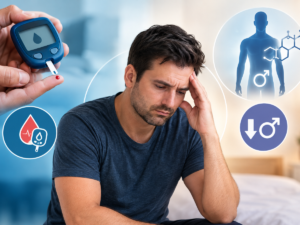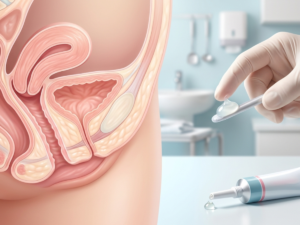

Testosterone therapy after prostate cancer may be an option for some men, but it is not safe or appropriate in every case. Men still undergoing treatment for prostate cancer are not good candidates for testosterone therapy.
However, men who have been successfully treated for prostate cancer and still have symptoms of low testosterone may be candidates for testosterone replacement therapy under certain conditions. The decision depends on cancer risk, the treatment received, current prostate-specific antigen (PSA), and any sign of prostate cancer recurrence.
Because testosterone can affect prostate tissue, men with this history need careful evaluation and ongoing monitoring. Those factors determine when therapy may be considered and when other options are more appropriate.
Why Was Testosterone Therapy Avoided After Prostate Cancer?
In 1941, Drs. Charles Huggins reported that bilateral castration (orchiectomy), or estrogen administration, sharply lowered elevated serum acid phosphatase in men with metastatic prostate cancer, often toward the normal range, and that injection of an androgen drug such as testosterone raised the acid phosphatase marker. Dr. Huggins treated the acid phosphatase enzyme changes as an objective marker of tumor activity and concluded that the cancer was androgen-dependent. A companion 1941 paper reported that castration often produced clinical improvement in advanced disease, while injected androgen (tesosterone) aggravated symptoms. Note: serum acid phosphatase is the precursor to the PSA test. (1, 2).
For more than 70 years, physicians treated Dr. Huggins findings as proof that testosterone directly fuels prostate cancer. They then assumed the reverse: restoring testosterone would reignite growth. That rule was applied even to men who had been treated and had no detectable disease. Click here to read Dr. Dach’s article which reviews how this belief became a clinical myth. (1, 2)
What Does the Saturation Model Explain About Testosterone and the Prostate?
In 2009, Drs. Abraham Morgentaler and Traish proposed the saturation model which states prostate androgen receptors are largely saturated at a low testosterone concentration. So, once this threshold is reached, more testosterone has little added effect on prostate growth (3). Below that point, small changes matter, which explains the beneficial response to castration. Above the saturation point, the response levels off.
That framework helps explain why later studies did not find the harm the older model predicted, and it is a major reason guidelines no longer impose a blanket ban on use of testosterone after treatment for prostate cancer. (3, 4). For the underlying PSA studies, see Dr. Dach’s review. (3, 4)
Is Testosterone Therapy Safe After Radical Prostatectomy?
In 2013, Dr. Alexander Pastuszak followed hypogonadal men given testosterone after prostatectomy and did not find a higher recurrence rate than in a reference group, including some higher-risk men (5). In 2018, Dr. John Mulhall and the American Urological Association panel likewise state that selected men with a history of prostate cancer may be considered for therapy after counseling that the risk cannot yet be quantified (4). In prostate organ-confined, low- or intermediate-risk disease with an undetectable PSA, available retrospective series have not shown an increased rate of biochemical recurrence. Note: biochemical recurrence means an increasing PSA. Because the prostate gland is removed, any confirmed detectable PSA is a warning of prostate cancer recurrence, regardless of testosterone use, so serial PSA testing remains essential. (4, 5)
What About Testosterone Therapy After Radiation or Brachytherapy?
In 2018, Dr. John Mulhall notes that men treated with radiation still have residual prostate tissue, so monitoring differs from surgery (4). Available studies are mostly small and retrospective, and they have not shown a clear increase in recurrence among carefully selected men who later started testosterone. After radiation treatment PSA is not expected to reach zero, and low PSA number is acceptable. To follow the patient for possible recurrence, serial PSA measurements are compared with the post-treatment nadir, i.e. the lowest PSA after radiation therapy is completed. Any increase in PSA from the post treatment value is suspicious for recurrence. Men who previously received androgen deprivation therapy (ADT) along with radiation have much less long-term safety data, and this combination calls for extra caution and a longer disease-free interval before testosterone is considered. (4, 5)
Can Men on Active Surveillance Use Testosterone Therapy?
Active surveillance means the prostate cancer is deemed indolent, and active treatment is deferred. Instead the urologist will “watch and wait” using serial PSA measurements. In 2024, Dr. Elie Kaplan-Marans reviewed SEER-Medicare data finding that testosterone therapy in men on active surveillance was not associated with conversion to active treatment or worse mortality (6). Because the cancer is still present, these men need more frequent PSA checks and close coordination with the urologist directing surveillance. Testosterone therapy does not replace scheduled biopsies or imaging. (6, 4)
Who Should Avoid Testosterone Therapy After Prostate Cancer?
In 2018, Dr. John Mulhall and the AUA panel advised against testosterone treatment for men who still want fertility, and Dr. John Mulhall requires individualized counseling for any man with a prostate-cancer history (4). Testosterone therapy is not appropriate for untreated high-risk prostate cancer, a detectable or rising PSA after treatment, or metastatic cancer. Men on androgen deprivation therapy (ADT) should not add testosterone, because ADT treatment works by suppressing testosterone. Giving exogenous testosterone would be counter productive. Evidence for testosterone use is strongest for disease-free men with low- or intermediate-risk cancer. High-risk and very high-risk cases have far less long-term data, so most specialists recommend a longer wait and a more conservative approach, if therapy is considered at all. (4, 3)
What Monitoring Is Required During Testosterone Therapy After Prostate Cancer?
2018, Dr. John Mulhall specifies on-treatment monitoring of testosterone and PSA, with the schedule set by cancer history, treatment, and response (4). Early follow-up is especially important. A confirmed rise in PSA is suspicious for recurrence and should be evaluated by the treating urologist, not assumed to be caused by testosterone. For a broader overview of the blood tests commonly used during treatment, see our guide to the best lab tests to monitor while on testosterone therapy. It explains which laboratory markers may be monitored during treatment and why they can be important for ongoing care. (4, 5)
Making the Decision With Your Care Team
The choice to start testosterone therapy after prostate cancer should never happen in isolation. It requires input from the urologist who managed the cancer diagnosis and a hormone specialist experienced in monitoring men with this history. The urologist who managed the prostate cancer should be in agreement. We review pathology, PSA history, and treatment records before recommending therapy, and we coordinate with the treating oncologist or urologist whenever testosterone after prostate cancer is considered.
If you believe low testosterone may be affecting your recovery, contact our Medical Director,Dr. Jeffrey Dach, to schedule an evaluation at our Davie, Florida office.
Frequently Asked Questions
Can testosterone therapy cause prostate cancer to come back?
In treated low- or intermediate-risk disease, current observational research has not shown a higher recurrence rate, but PSA monitoring remains essential (5).
How long should a man wait after treatment?
There is no single timeline. Most specialists wait until PSA has stabilized and stayed undetectable or steady for a meaningful period (4).
Is testosterone therapy safe on active surveillance?
Population data have not linked it to faster progression in low-risk patients, but closer PSA and biopsy monitoring is required (6).
What PSA level should stop testosterone therapy?
Any confirmed rising trend should prompt a pause and urologic evaluation before therapy continues. Learnwhat happens when you stop testosterone therapy.
Can men on androgen deprivation therapy use testosterone therapy?
No. Androgen deprivation works by suppressing testosterone, so adding it directly opposes that treatment (4).
Articles with Related Interest:
Testosterone, PSA and Prostate Cancer Myths and Misconceptions Benefits of Testosterone Therapy
PSA and Testosterone Observations Part Two
Low Testosterone Associated with Increased Mortality
References
1. Huggins, Charles, and Clarence V. Hodges. “Studies on Prostatic Cancer. I. The Effect of Castration, of Estrogen and of Androgen Injection on Serum Phosphatases in Metastatic Carcinoma of the Prostate.” Cancer Research, vol. 1, no. 4, 1941, pp. 293–97. https://aacrjournals.org/cancerres/article/1/4/293/449790/Studies-on-Prostatic-CancerI-The-Effect-of
2. Huggins, Charles, et al. “Studies on Prostatic Cancer: II. The Effects of Castration on Advanced Carcinoma of the Prostate Gland.” Archives of Surgery, vol. 43, no. 2, 1941, pp. 209–23. https://jamanetwork.com/journals/jamasurgery/fullarticle/545269
3. Morgentaler, Abraham, and Abdulmaged M. Traish. “Shifting the Paradigm of Testosterone and Prostate Cancer: The Saturation Model and the Limits of Androgen-Dependent Growth.” European Urology, vol. 55, no. 2, 2009, pp. 310–20. https://doi.org/10.1016/j.eururo.2008.09.024
4. Mulhall, John P., et al. “Evaluation and Management of Testosterone Deficiency: AUA Guideline.” The Journal of Urology, vol. 200, no. 2, 2018, pp. 423–32. https://doi.org/10.1016/j.juro.2018.03.115
5. Pastuszak, Alexander W., et al. “Testosterone Replacement Therapy in Patients with Prostate Cancer after Radical Prostatectomy.” The Journal of Urology, vol. 190, no. 2, 2013, pp. 639–44. https://pubmed.ncbi.nlm.nih.gov/23395803/
6. Kaplan-Marans, Elie, et al. “Oncologic Outcomes of Testosterone Therapy for Men on Active Surveillance for Prostate Cancer: A Population-based Analysis.” European Urology Open Science, 2024, PMC10874869. https://pmc.ncbi.nlm.nih.gov/articles/PMC10874869/