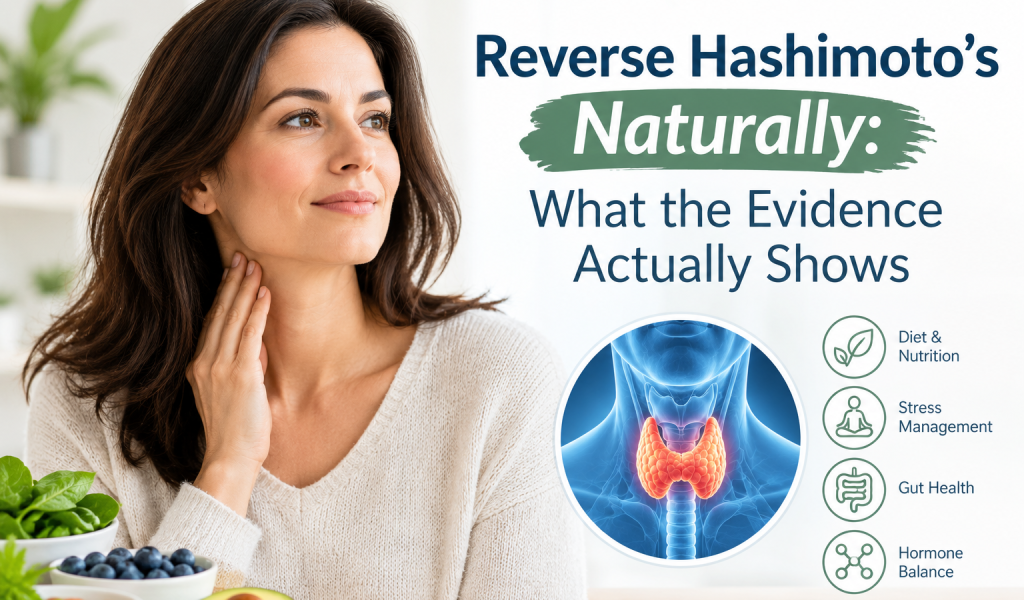
Hashimoto’s thyroiditis is an autoimmune attack on the thyroid that often leads to hypothyroidism. Patients ask whether natural steps and thyroid medication can reverse it. We do see gradual reduction in antibody levels in most of our patients under treatment. However, complete restoration of already damaged thyroid tissue is not possible. With treatment, thyroid antibody levels can fall, symptoms can ease, and a minority of patients can even discontinue thyroid hormone for a time.
Our treatment program involves serial monitoring of thyroid hormone levels to adjust thyroid medication dosage.
How Often Do Autoimmune Thyroid Patients Go Into Remission?
In 1992, Dr. Nobuyuki Takasu and colleagues reported that thyrotropin-blocking antibodies disappeared in a subset of patients with autoimmune thyroiditis, allowing spontaneous recovery of thyroid function after levothyroxine withdrawal (1).
In 1995, Dr. R. Comtois and coauthors followed 79 adults with Hashimoto’s-related hypothyroidism; after one year of treatment and a withdrawal trial, about 11 percent normalized thyroid function, more often when goiter was larger and initial TSH higher (2).
Pediatric data are similar. In 2025, Dr. Ayşe Yaşar and colleagues followed 233 children and adolescents for at least three to five years; antibody levels declined significantly by year five, and a small proportion with overt hypothyroidism became euthyroid (normal) and stopped levothyroxine (3).
A 2020 Frontiers in Endocrinology review of childhood autoimmune thyroiditis noted that roughly 16 percent of those presenting with overt hypothyroidism recovered enough to stop therapy (4).
These studies show the disease is dynamic, not inevitably progressive in every case. They do not show that natural measures alone reverse structural damage. (1-4)
What About Selenium?
It is important not to miss selenium deficiency which impairs thyroid function and can cause thyroid damage. The thyroid relies on selenium-dependent enzymes to neutralize hydrogen peroxide, which is used in the production of thyroid hormone. This is the reason we test for serum selenium routinely for every patient. When selenium is found low, we provide selenium supplements. For more on this, see what the research says about selenium and Hashimoto’s.
How can we lower anti-thyroid antibodies? Studies on selenium supplementation have the strongest data for lowering the anti-thyroid antibodies. In 2024, Dr. Valentina V. Huwiler and colleagues published a systematic review and meta-analysis of 35 randomized trials. Selenium significantly reduced TPOAb (TPO antibody) and lowered TSH in patients not already on thyroid hormone, with adverse events comparable to placebo (5).
In three small clinical trials Drs.Mazokopakis 2007, Gärtner 2002, and Turker 2006 reported 20–40 percent antibody reductions in anti-thyroid antibodies using 200 mcg selenomethionine. Selenium is protective of thyroid tissue when using high dose iodine. Selenium is a prerequisite before starting any high dose iodine protocol. (10-13)
For more on this see: Hashimotos Thyroiditis and Selenium Part One.
And see: Hashimotos Selenium and Iodine Part Two .
Gluten Free Diet
We advise all Hashimoto’s patients to go on a gluten-free diet. Here are a few studies suggesting benefits. In 2019, Dr. Robert Krysiak and colleagues conducted a pilot study of 34 euthyroid, drug-naïve women with Hashimoto’s and positive anti-tissue transglutaminase antibodies; after six months the gluten-free group showed reduced TPOAb and TgAb titers and slight gains in vitamin D and estimated thyroid secretory capacity (6).
In 2021, Dr. Jacek Pobłocki and coauthors randomized 62 women for 12 months; the gluten-free group had a significant TSH reduction and a within-group decline in anti-TG, though between-group antibody differences were not significant (7).
In 2023, Dr. Tommaso Piticchio and colleagues meta-analyzed four prospective studies (87 patients); TSH fell and free T4 rose significantly, with non-significant trends toward lower antibodies that were stronger when gluten-related conditions were present (8).
A 2023 American Family Physician summary noted possible antibody reductions of about 24 percent in euthyroid (normal thyroid) drug-naïve women and a TSH-lowering signal, but no clear symptom benefit overall (9).
All hashimoto’s patients are routinely tested for gluten sensitivity using anti-gliadin antibodies, and advised to go on a gluten-free diet when positive. We also suggest elimination of junk food. Our complete Hashimoto’s diet guide covers gluten in more detail. For more on this topic see: Addressing the Autoimmune Component of Autoimmune Thyroid Disease
Vitamin D Deficiency
Vitamin D deficiency is more common in patients with autoimmune thyroid disease, and some observational data link low levels of vitamin D to higher anti-thyroid antibodies. Studies on myo-inositol combined with selenium show reduction in TSH and thyroid antibodies, as detailed in my 2023 article “MyoInositol for Hashimotos Part Two” which cites Nordio trials showing roughly 40 percent antibody decline and TSH normalization in subclinical cases. See these two articles:
Myoinositol for PCOS and Hashimotos Part One
MyoInositol for Hashimotos Part Two
Chronic stress
Chronic stress can trigger flares, as we explain in our article on how stress can trigger Hashimoto’s flare-ups. Managing it may reduce flare frequency, but it rarely eliminates antibodies. Thyroid medication with suppression of TSH will help reduce anti-thyroid antibodies and prevent Hashitoxicosis flare-ups.
Thyroid Medication for Hashimoto’s Disease
Supplements and natural remedies can work together with thyroid medication to help the Hashimoto’s patient. However, low thyroid symptoms usually return upon discontinuing thyroid hormone medication. For euthyroid Hashimoto’s with elevated antibodies, early treatment with thyroid hormone (preferably natural desiccated thyroid containing T3 and T4) plus selenium can reduce inflammatory markers more effectively than either alone, as shown in the 2011 Krysiak trial as discussed here: Hashimoto’s Thyroiditis with Normal TSH, When to Treat?
How often do we check thyroid levels? The following laboratory tests, TSH, free T3, FreeT4 reverse T3, and TPO and TgAb thyroid antibodies are usually rechecked every six months, or more frequently if needed.
If the TSH is normal, mainstream endocrinology will dogmatically withhold thyroid medication from the Hashimoto’s patient. This is true even though the anti-thyroid antibodies are quite high. I do not agree with this mainstream dogma, which is an error in modern thyroid endocrinology. Our approach is to treat the Hashimoto’s patient early even if the TSH is within the lab range. For more on this, see: Hashimoto’s Thyroiditis with Normal TSH, When to Treat?
Our guide to evidence-based supplements for thyroid support covers selenium, vitamin D, zinc, iron, and iodine, and thyroid testing. A useful panel includes thyroid hormones, anti-thyroid antibodies, and various nutrients. Remember, a normal TSH alone does not rule out a thyroid problem.
We offer lab testing through Quest and Labcorp, as described on our services page.
If you already take levothyroxine and still feel poorly, read why you may still feel tired on levothyroxine. Some patients feel better switching to natural desiccated thyroid (NDT).
How Do We Approach Your Thyroid Lab Numbers?
We look beyond TSH alone. Our panel includes free T3, free T4, TPO antibodies, reverse T3 and other markers, and we interpret lab results in light of your clinical history, symptoms and physical examination. Your clinical symptoms are carefully considered when reviewing the laboratory studies. Are the laboratory studies in agreement with your clinical symptoms, or are they discordant? Such a thought process is carried out before recommending a treatment plan.
If we start medication, we repeat labs after six weeks, then every six months once on a maintenance dosage of thyroid medication. If you already take levothyroxine and still feel poorly, our article on why you may still feel tired on levothyroxine explains the next steps. Our thyroid treatment in South Florida includes lab testing through Quest and Labcorp.
What Should You Do Next?
Before your thyroid specialist appointment, gather three things:
- A list of your symptoms, and timing of when improved or worsened
- A list of supplements and medications with their dosage
- Any previous thyroid laboratory studies
If you are a Hashimoto’s patient, feel free to contact the TruemedMD clinic in Davie, Florida to discuss a full evaluation and treatment program.
Frequently Asked Questions
1. Can you reverse Hashimoto’s naturally?
In a small percentage of children and adults, Hashimoto’s thyroiditis will go into remission with treatment. For patients under treatment, antibody levels and symptoms improve, and a minority of patients recover function, but already damaged tissue is irreversible.
2. Does a gluten-free diet lower thyroid antibodies?
Small studies and one meta-analysis show encouraging results in selected groups. Dr. Dach advises all hashimoto’s patients to go on a gluten free diet.
3. Should I take selenium for Hashimoto’s?
Yes, when selenium levels are low with elevated antibodies, we give selenium supplementation. Published meta-analyses support the use of selenium for antibody reduction.
4. Do high thyroid antibodies always need treatment?
Although mainstream medicine will not treat the Hashimoto’s patient if thyroid hormone levels are normal, this is an error. The medical literature supports the early treatment of Hashimoto’s patients even when thyroid labs are normal. This is explained more completely in my article: Hashimoto’s Thyroiditis with Normal TSH, When to Treat?
5. Should I stop thyroid medication if I feel better?
No, do not stop or change dosage on your own. Any change in thyroid dosage is based on clinical findings and laboratory studies after a discussion with your physician.
6. How is Hashimoto’s disease usually diagnosed?
Hashimoto’s thyroiditis is diagnosed by the elevation of thyroglobulin and thyroperoxidase antibodies. Our complete thyroid lab panel includes TSH, free thyroid hormones (FreeT3 and FreeT4), reverse T3 and TPO/thyroglobulin antibodies. Thyroid Ultrasound is useful when antibodies are negative.
Conclusion: For the typical Hashimoto’s patients under treatment at the TruemedMD clinic in Davie, Florida, we see antibody levels gradually decline over time. Obviously, restoration of damaged thyroid tissue is not reversible. Selenium, a gluten-free diet, vitamin D optimization, myo-inositol, and stress management all work together to benefit the hashimoto’s patient. We treat the Hashimoto’s patient with thyroid medication early, with the goal of TSH suppression. This is our protocol for Hashimoto’s patients.
Articles with Related Interest
Addressing the Autoimmune Component of Autoimmune Thyroid Disease
Hashimoto’s Thyroiditis with Normal TSH, When to Treat?
Hashimotos Thyroiditis and Selenium Part One
Hashimotos Selenium and Iodine Part Two
Myo-Inositol for Hashimotos Part Two
References:
1. Takasu, Nobuyuki, et al. “Disappearance of Thyrotropin-Blocking Antibodies and Spontaneous Recovery from Hypothyroidism in Autoimmune Thyroiditis.” New England Journal of Medicine, vol. 326, no. 8, 1992, pp. 513–18. https://www.nejm.org/doi/full/10.1056/NEJM199202203260803.
2. Comtois, R., et al. “Outcome of Hypothyroidism Caused by Hashimoto’s Thyroiditis.” Archives of Internal Medicine, vol. 155, no. 13, 1995, pp. 1404–08. https://pubmed.ncbi.nlm.nih.gov/7794089/.
3. Yaşar, Ayşe, et al. “Hashimoto’s Thyroiditis in Children and Adolescents: Analysis of Long-Term Course.” Journal of Pediatric Endocrinology and Metabolism, 2025. https://pubmed.ncbi.nlm.nih.gov/40888765/.
4. “Long-Term Follow-Up and Outcomes of Autoimmune Thyroiditis in Childhood.” Frontiers in Endocrinology, vol. 11, 2020, article 309. https://www.frontiersin.org/journals/endocrinology/articles/10.3389/fendo.2020.00309/full
5. Huwiler, Valentina V., et al. “Selenium Supplementation in Patients with Hashimoto Thyroiditis: A Systematic Review and Meta-Analysis of Randomized Clinical Trials.” Thyroid, vol. 34, no. 3, 2024, pp. 295–313. https://doi.org/10.1089/thy.2023.0556.
6. Krysiak, Robert, et al. “The Effect of Gluten-Free Diet on Thyroid Autoimmunity in Drug-Naïve Women with Hashimoto’s Thyroiditis: A Pilot Study.” Experimental and Clinical Endocrinology & Diabetes, vol. 127, no. 7, 2019, pp. 417–22. https://doi.org/10.1055/a-0653-7108.
7. Pobłocki, Jacek, et al. “Whether a Gluten-Free Diet Should Be Recommended in Chronic Autoimmune Thyroiditis or Not?—A 12-Month Follow-Up.” Journal of Clinical Medicine, vol. 10, no. 15, 2021, article 3240. https://doi.org/10.3390/jcm10153240.
8. Piticchio, Tommaso, et al. “Effect of Gluten-Free Diet on Autoimmune Thyroiditis Progression in Patients with No Symptoms or Histology of Celiac Disease: A Meta-Analysis.” Frontiers in Endocrinology, vol. 14, 2023, article 1200372. https://www.frontiersin.org/journals/endocrinology/articles/10.3389/fendo.2023.1200372/full.
9. “Does a Gluten-Free Diet Reduce Symptoms of Autoimmune Thyroid Disease?” American Family Physician, vol. 108, no. 1, July 2023, pp. 87–88. https://www.aafp.org/afp/2023/0700/fpin-hda-gluten-free-diet-thyroid-disease.
10. Xu, Jian, et al. “Supplemental Selenium Alleviates the Toxic Effects of Excessive Iodine on Thyroid.” Biological Trace Element Research, vol. 141, no. 1-3, 2011, pp. 110–18. https://doi.org/10.1007/s12011-010-8728-8.
11. Köhrle, Josef. “Selenium, Iodine and Iron–Essential Trace Elements for Thyroid Hormone Synthesis and Metabolism.” International Journal of Molecular Sciences, vol. 24, no. 4, 2023, article 3393. https://doi.org/10.3390/ijms24043393.
12. Dijck-Brouwer, D. A. Janneke, et al. “Thyroidal and Extrathyroidal Requirements for Iodine and Selenium: A Combined Evolutionary and (Patho)Physiological Approach.” Nutrients, vol. 14, no. 19, 2022, article 3886. https://doi.org/10.3390/nu14193886.
13. Zimmermann, Michael B., and Josef Köhrle. “The Impact of Iron and Selenium Deficiencies on Iodine and Thyroid Metabolism: Biochemistry and Relevance to Public Health.” Thyroid, vol. 12, no. 10, 2002, pp. 867–78. https://doi.org/10.1089/105072502761016494.