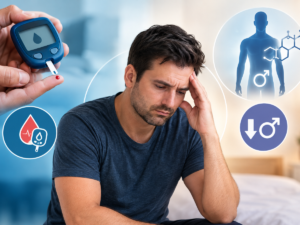

Can testosterone therapy help men with prediabetes improve blood sugar control? Research suggests testosterone treatment may improve insulin sensitivity and glucose metabolism in men with confirmed testosterone deficiency, also called low testosterone. However testosterone therapy is not first-line treatment for the prediabetic male. Rather, low-carbohydrate diet and exercise is recommended as first line treatment.
For a male with mildly elevated fasting blood sugar and a slightly elevated hemoglobin A1C of 5.9%, the first recommendation would be dietary modification: eliminate added sugars, reduce carbohydrate intake, increase physical activity, and work toward a healthy weight. Even with these lifestyle changes, fasting blood sugar and hemoglobin A1C may remain elevated. In this scenario, evaluating testosterone levels to identify possible testosterone deficiency may be worthwhile. Understanding the relationship between testosterone therapy and blood sugar can help guide further evaluation, although treatment decisions should be based on individual symptoms, laboratory results, and clinical assessment. That said, we include testosterone levels in all routine laboratory panels for new patients.
Understanding the connection between testosterone, insulin resistance, and blood sugar can help determine whether testosterone therapy has a role alongside proven prediabetes treatments.
The Overlooked Link Between Low Testosterone and Blood Sugar
Mainstream medicine considers prediabetes a diet and lifestyle issue. This is quite correct. However, for many men, prediabetes is also a low testosterone problem. Testosterone helps muscle tissue pull glucose out of the bloodstream into cells where it is used for energy. When testosterone declines, glucose uptake and metabolism slows down, resulting in prolonged elevation of post-prandial blood sugar as demonstrated by the oral glucose tolerance test (OGTT). Note: postprandial means after meals.
Males with low testosterone also tend to accumulate more visceral fat, the kind of fat that wraps around the internal organs rather than located subcutaneously, just underneath the skin. The problem with visceral fat is the release of inflammatory cytokines that worsens insulin resistance and metabolic syndrome. Thus, making our cells resistant to insulin. The result is the visceral-fat feedback loop: low T raises insulin resistance, insulin resistance raises fat storage, and fat storage lowers testosterone even further. This feedback loop includes suppression of the hypothalamic-pituitary-testicular axis (HPA), and increased aromatization of testosterone to estrogen.(1-3)
This is a common scenario in our office for men seeking evaluation of testosterone levels after their primary care doctor has already discovered they have prediabetes.
It may be useful to review the signs of low testosterone in men to understand if testosterone therapy would be useful for you. As we age, testosterone levels decline, so if you assume your symptoms are just part of getting older, you might be correct about that.
How Testosterone Therapy Affects Insulin Resistance
Restoring testosterone to a healthy range does not act like a diabetes drug like metformin. Testosterone works upstream to the problem by improving mitochondrial function and insulin sensitivity. (1-3)
Muscle Mass and Glucose Uptake
Testosterone supports lean muscle. Muscle is the body’s largest site for glucose utilization, so more functional muscle mass means blood sugar clears out of the bloodstream faster after meals.
Visceral Fat Reduction
Men on properly monitored testosterone therapy frequently lose visceral fat over several months of treatment. Less visceral fat means less inflammatory signaling working against insulin.
Insulin Sensitivity at the Cellular Level
Testosterone receptors sit on fat and muscle cells and influence how those cells respond to insulin. When testosterone is restored, insulin signaling tends to improve, which is the core mechanism behind testosterone and insulin resistance research published over the past two decades. For more on this, see this article: Testosterone Reduces Mortality in Diabetic Males. (1-11)
What the Research Shows on Testosterone Therapy and Prediabetes
Multiple clinical studies have tracked glucose metabolism in hypogonadal men receiving treatment. Men with low baseline testosterone and impaired fasting glucose showed measurable improvements in insulin sensitivity and modest reductions in fasting glucose after sustained therapy. (1-11)
The effect is not universal or immediate. Testosterone therapy works best as part of a plan that includes nutrition and activity, not as a replacement for either. Men who combine treatment with resistance training see the clearest metabolic gains, since muscle built under adequate testosterone becomes an active glucose sink.
Testosterone therapy for the male with prediabetes requires follow up with real laboratory tracking. This eliminates the guesswork. We do not prescribe testosterone based on symptoms alone. We first do a complete laboratory panel, checking total and free testosterone, estradiol, FSH and LH, fasting glucose, hemoglobin A1C, chem panel, fasting insulin, CBC, iron and ferritin, and complete thyroid panel. And this is a subset of a larger and more complete panel that looks at many other parameters such as CRP, cortisol, B12 level, magnesium, selenium, antigliadin antibodies, lipoprotein (a) and H. pylori breath test. When appropriate, we go on to additional lab testing, medical imaging or refer you to a specialist as needed.
Benefits Beyond Blood Sugar Control
Prediabetic males who start testosterone therapy often notice symptom improvement fairly early. These are:
- Energy that holds steady through the afternoon instead of crashing.
- Faster recovery after workouts, which makes resuming regular exercise possible.
- Improved mood and mental clarity, since low T is tied to both.
- Better sleep quality in many cases, further supporting healthy glucose regulation.
A deeper look at the weight loss and metabolic benefits of testosterone in men shows how closely hormone balance and body composition are connected. Fixing one tends to also fix the other.
Is Testosterone Therapy Right for You?
Not every man with prediabetes has low testosterone, and not every man with low testosterone needs therapy right away. How to decide? We start with a full evaluation including bloodwork, not guesswork.
At our TruemedMD clinic, medical director, Jeffrey Dach, MD will review your complete metabolic and hormone panel, and then discuss your treatment plan. A low testosterone level in a male means good candidate for testosterone therapy. If the testosterone level is high, then obviously not a good candidate.

We may sometimes need a second early AM blood draw to confirm the findings. Typical low testosterone symptoms include fatigue, reduced muscle strength, or difficulty with weight loss. Hypogonadal men with prediabetes or early type 2 diabetes are frequently good candidates for testosterone therapy for low T (low testosterone).
In younger males with low testosterone who wish to preserve fertility, rather than testosterone, we look for other ways to increase endogenous production of testosterone while preserving fertility. One such alternative option is a fertility drug called clomid.
Take Control of Your Metabolic Health
If your blood sugar fails to respond to diet modification and exercise, low testosterone could be part of the reason, and testosterone therapy part of the solution. At our Truemedmd clinic, medical director Jeffrey Dach MD builds a treatment plan for you. We use actual lab results, not guesswork, to give you clear answers.
If you are struggling to maintain a healthy blood sugar, contact us today to schedule a medical evaluation which includes a complete laboratory panel, physical examination, treatment plan, and continued follow up. Evaluation includes hormone levels and metabolic parameters to find out if testosterone therapy is right for you.
Frequently Asked Questions
Can testosterone therapy reverse prediabetes on its own?
Testosterone therapy can improve insulin sensitivity and support blood sugar control, but is more effective when combined with diet modification and strength training. Testosterone is less effective as standalone therapy. (1-11)
How long before blood sugar improves on testosterone therapy?
Most patients see meaningful changes in fasting glucose and hemoglobin A1C within three to six months of testosterone therapy. Our testosterone therapy program is carefully monitored with frequent follow calls and serial laboratory testing.
Does low testosterone actually cause prediabetes?
Low testosterone does not directly cause prediabetes, but it worsens insulin resistance and promotes visceral fat in a feedback loop, driving metabolic syndrome, prediabetes and blood sugar problems. (1-3)
What tests confirm I am a candidate for treatment?
We check total and free testosterone, estradiol, FSH and LH, fasting glucose, hemoglobin A1C, chem panel, fasting insulin, CBC, iron and ferritin, and complete thyroid panel. And this is a subset of a larger and more complete panel that looks at many other parameters. It is sometimes useful to have a second early morning (AM) testosterone level drawn to confirm initial findings.
Is testosterone therapy safe for men with prediabetes?
When properly monitored with regular labs, testosterone therapy is generally safe for men with prediabetes when properly monitored.
Conclusion
As mentioned above, low testosterone is a health risk and contributes to a vicious feedback loop in prediabetic men. Testosterone therapy is beneficial in this group of prediabetics who usually see improvement with insulin resistance, less visceral fat, improved muscle mass, improved libido, better mood and cognitive function. Studies also show diabetic males with low testosterone have increased mortality. However, after testosterone therapy, mortality returns to normal.
Articles with Related Interest:
Testosterone Reduces Mortality In Diabetic Males
Testosterone Reduces Mortality in Males
Testosterone Found Beneficial for Diabetic Males
Low Testosterone Diagnosis and Treatment
All Testosterone Articles by Jeffrey Dach MD
References:
1. Pitteloud, Nelly, et al. “Relationship Between Testosterone Levels, Insulin Sensitivity, and Mitochondrial Function in Men.” Diabetes Care, vol. 28, no. 7, July 2005, pp. 1636–42, https://doi.org/10.2337/diacare.28.7.1636.
2. Grossmann, Mathis. “Testosterone and Glucose Metabolism in Men: Current Concepts and Controversies.” Journal of Endocrinology, vol. 220, no. 3, 2014, pp. R37–R55,
3. Rao, Preethi M., Daniel M. Kelly, and T. Hugh Jones. “Testosterone and Insulin Resistance in the Metabolic Syndrome and T2DM in Men.” Nature Reviews Endocrinology, vol. 9, no. 8, Aug. 2013, pp. 479–93,
4. Yassin, Aksam, et al. “Testosterone therapy in men with hypogonadism prevents progression from prediabetes to type 2 diabetes: eight-year data from a registry study.” Diabetes Care 42.6 (2019): 1104-1111.
5. Haider, Karim Sultan, et al. “Remission of type 2 diabetes following long‐term treatment with injectable testosterone undecanoate in patients with hypogonadism and type 2 diabetes: 11‐year data from a real‐world registry study.” Diabetes, Obesity and Metabolism 22.11 (2020): 2055-2068.
6. Caliber, Monica, and Farid Saad. “Testosterone therapy for prevention and reversal of type 2 diabetes in men with low testosterone.” Current Opinion in Pharmacology 58 (2021): 83-89.
7. Hackett, Geoffrey, et al. “Testosterone undecanoate improves sexual function in men with type 2 diabetes and severe hypogonadism: results from a 30‐week randomized placebo‐controlled study.” BJU international 118.5 (2016): 804-813.
8. Kumar, Satesh, et al. “Effects of testosterone therapy in adult males with hypogonadism and T2DM: a meta-analysis and systematic review.” Diabetes & Metabolic Syndrome: Clinical Research & Reviews 16.8 (2022): 102588.
9. Kapoor, Dheeraj, et al. “Testosterone Replacement Therapy Improves Insulin Resistance, Glycaemic Control, Visceral Adiposity and Hypercholesterolaemia in Hypogonadal Men with Type 2 Diabetes.” European Journal of Endocrinology, vol. 154, no. 6, June 2006, pp. 899–906,
10. Jones, T. Hugh, et al. “Testosterone Replacement in Hypogonadal Men with Type 2 Diabetes and/or Metabolic Syndrome (the TIMES2 Study).” Diabetes Care, vol. 34, no. 4, Apr. 2011, pp. 828–837,
11. Wittert, Gary, et al. “Testosterone Treatment to Prevent or Revert Type 2 Diabetes in Men Enrolled in a Lifestyle Programme (T4DM): A Randomised, Double-Blind, Placebo-Controlled, 2-Year, Phase 3b Trial.” The Lancet Diabetes & Endocrinology, vol. 9, no. 1, Jan. 2021, pp. 32–45.